Technology
Verified dataA terabyte of storage cost $88 billion in 1956. Today it costs $10.
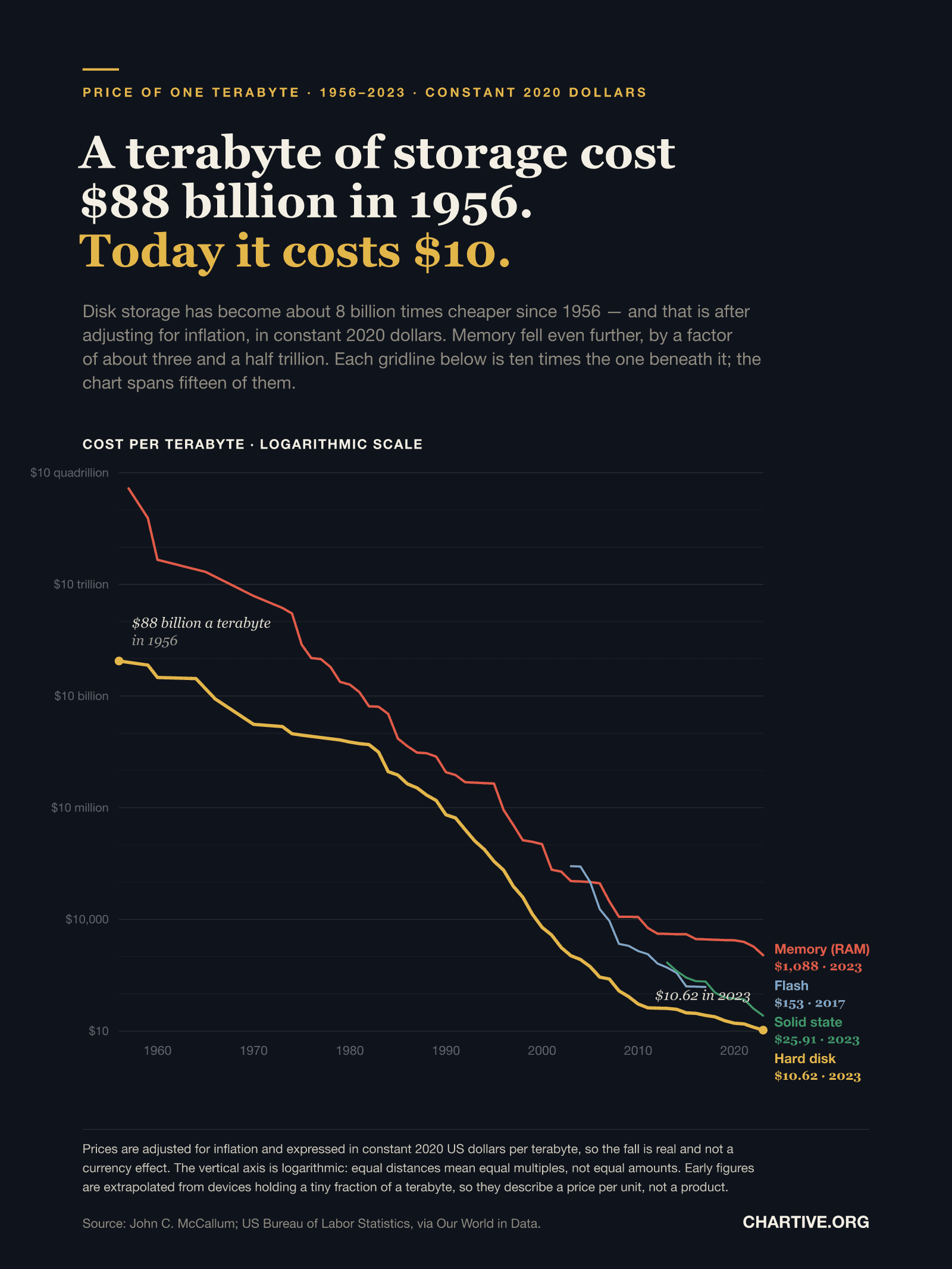
Disk storage has become about 8 billion times cheaper since 1956 — and that is after adjusting for inflation, in constant 2020 dollars. Computer memory fell even further, by a factor of about three and a half trillion.
CSV · 59 rows · 1956–2023
Storing one terabyte on hard disks cost the equivalent of $87.5 billion in 1956 and $10.62 in 2023, both in constant 2020 dollars — a fall by a factor of 8.2 billion. Computer memory fell even faster, from $3.8 quadrillion per terabyte in 1957 to $1,088 in 2023, a factor of about 3.5 trillion. The decline is close to a straight line on a logarithmic scale, meaning the price fell by a roughly constant multiple decade after decade for almost seventy years.
Key findings
- A terabyte of hard-disk storage cost the equivalent of $87.5 billion in 1956 and $10.62 in 2023, in constant 2020 dollars.
- That is a fall by a factor of 8.2 billion — and it is a real fall, not an inflation effect.
- Computer memory dropped even further: from $3.8 quadrillion per terabyte in 1957 to $1,088, a factor of about 3.5 trillion.
- By 1990 a terabyte of disk still cost $6.5 million; by 2000 it was $6,120; by 2010, $53.
- The decline is close to a straight line on a logarithmic scale — a roughly constant multiple every decade for nearly seventy years.
- Solid-state drives fell from $694 per terabyte in 2013 to $25.91 in 2023, still about 2.4 times the price of spinning disks.
Explore the data
Coverage: Jan 1, 1956 – Dec 31, 2023 · United States
Free to download and reuse. Get the data behind every new chart →
Sources
Primary source
Historical cost of computer memory and storage
John C. McCallum; US Bureau of Labor Statistics, via Our World in Data
Price of memory, disk, flash and solid-state storage per terabyte
Accessed Aug 30, 2026
Advertised US prices compiled by John C. McCallum, expressed per terabyte and deflated to constant 2020 US dollars using the BLS consumer price index.
Methodology
Prices come from John C. McCallum's long-running compilation of advertised prices for computer memory and storage, deflated to constant 2020 US dollars using the US Bureau of Labor Statistics consumer price index, as published by Our World in Data. Four technologies are shown: magnetic hard disks, random access memory, flash memory and solid-state drives, each beginning in the year its series starts. The vertical axis is logarithmic and spans fifteen powers of ten, from $10 to $10 quadrillion per terabyte; on such a scale equal vertical distances represent equal multiples rather than equal dollar amounts, which is what makes a decline of this magnitude legible at all.
What this does not show
Early figures are extrapolations. No device in 1956 held anything close to a terabyte — the first hard disk stored about 3.75 megabytes — so the early values describe a price per unit of capacity scaled up, not the price of a product anyone could buy. Prices are advertised US retail prices, which vary between vendors and over the course of a year, and the series does not capture performance, reliability or physical size, all of which improved enormously alongside price. The inflation adjustment uses a general consumer price index, which is a reasonable but not exact deflator for capital equipment. Flash memory ends in 2017 in this source and is not directly comparable to the solid-state drive series.
Creator
Reuse this visualization

Cite this
License: CC BY 4.0
Embed code
<figure style="margin:0;max-width:1600px">
  <a href="https://chartive.org/visualizations/storage-cost-1956-2023" target="_blank" rel="noopener">
    <img src="https://chartive.org/infographics/storage-cost-1956-2023.png" alt="Logarithmic line chart of the inflation-adjusted price of one terabyte of storage from 1956 to 2023, spanning fifteen powers of ten from ten dollars to ten quadrillion dollars. A red line for memory falls from about $3.8 quadrillion per terabyte in 1957 to $1,088 in 2023. A gold line for hard disks falls from $87.5 billion in 1956 to $10.62 in 2023. Shorter blue and green lines show flash memory ending at $153 in 2017 and solid-state drives at $25.91 in 2023. Both long lines descend in an almost straight diagonal across the whole chart." width="1600" height="2133" style="max-width:100%;height:auto" />
  </a>
  <figcaption style="font:14px/1.4 system-ui,sans-serif;color:#57534e;margin-top:8px">
    Graphic by Chartive Editorial, using data from Historical cost of computer memory and storage — via <a href="https://chartive.org/visualizations/storage-cost-1956-2023" target="_blank" rel="noopener">Chartive</a>
  </figcaption>
</figure>
Reuse is welcome — the embed keeps a link back to the source.