Society
Verified dataThe number of migrants has doubled. Their share of humanity has barely moved.
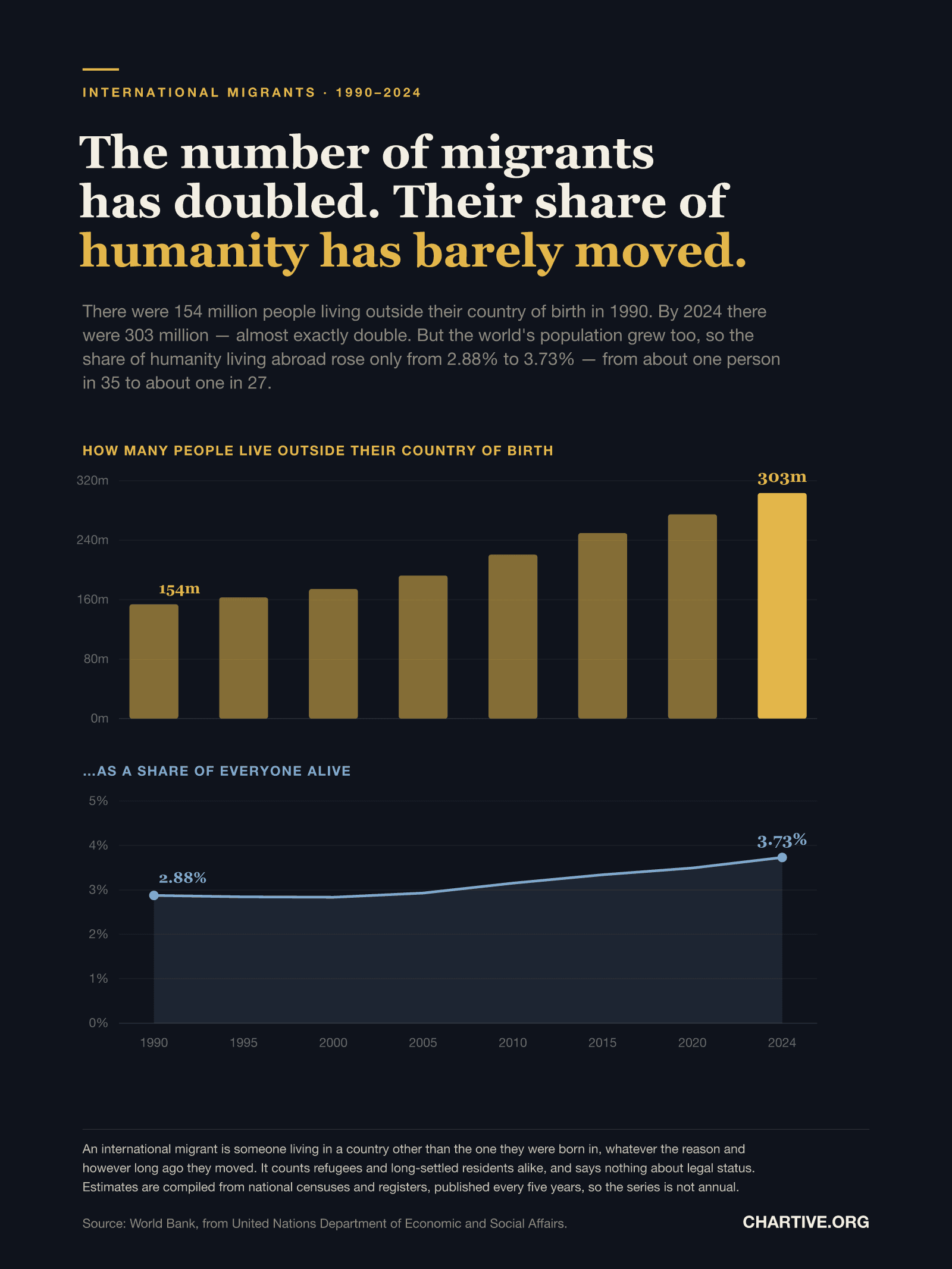
There were 154 million people living outside their country of birth in 1990. By 2024 there were 303 million — almost exactly double. But because the world's population grew too, the share living abroad rose only from 2.88% to 3.73%.
CSV · 8 rows · 1990–2024
International migration looks very different depending on which number you use. In absolute terms it has doubled since 1990, from 154 million people to 303 million. As a share of everyone alive it has risen far less — from 2.88% to 3.73%, or from roughly one person in 35 to one in 27. Both figures are correct, and they support very different impressions of how much the world has changed. Migrants remain heavily concentrated in a few destinations: the United States alone hosts 52 million of them, 17% of the global total.
Key findings
- The number of people living outside their country of birth rose from 154 million in 1990 to 303 million in 2024.
- That is almost exactly a doubling — a factor of 1.97 over 34 years.
- As a share of world population the rise is far smaller: from 2.88% to 3.73%, up 0.85 percentage points.
- In everyday terms, that is a move from about one person in 35 to about one in 27.
- The share actually fell slightly during the 1990s, from 2.88% to 2.83% in 2000, before rising.
- Migrants are concentrated: the United States hosts 52.4 million, 17% of the world total.
- Germany is second with 16.8 million and Saudi Arabia third with 13.7 million; the top three together host 27%.
Explore the data
Coverage: Jan 1, 1990 – Dec 31, 2024 · World
Free to download and reuse. Get the data behind every new chart →
Sources
Primary source
International migrant stock
United Nations Department of Economic and Social Affairs, via the World Bank
International migrant stock, total and as a share of population
Accessed Aug 30, 2026
World Bank series SM.POP.TOTL and SM.POP.TOTL.ZS, compiled by UN DESA from national censuses and population registers. Host-country figures for 2024 are from the same series.
Methodology
An international migrant is defined as a person living in a country other than the one they were born in, regardless of when they moved, why, or under what legal status. Figures are the United Nations Department of Economic and Social Affairs' international migrant stock estimates, published through the World Bank as series SM.POP.TOTL and SM.POP.TOTL.ZS. The two panels use separate, honest axes rather than a shared one: the upper panel counts people and the lower panel shows the same population as a percentage of world population, both starting at zero. Estimates are compiled roughly every five years from national censuses and population registers, which is why the series is not annual.
What this does not show
The measure is a stock, not a flow: it counts everyone currently living outside their country of birth, including people who moved decades ago, so it is not a measure of how many people migrated in a given year. It makes no distinction between refugees, students, workers and long-settled residents, and says nothing about legal status. Definitions and data quality vary between countries, and some large migrant populations are known to be undercounted. Border changes can also create migrants without anyone moving — the break-up of the Soviet Union added millions to the 1990s figures on paper.
Creator
Reuse this visualization
Cite this
License: CC BY 4.0
Embed code
<figure style="margin:0;max-width:1600px">
  <a href="https://chartive.org/visualizations/world-migration-1990-2024" target="_blank" rel="noopener">
    <img src="https://chartive.org/infographics/world-migration-1990-2024.png" alt="Two stacked panels covering 1990 to 2024. The upper panel is a bar chart of international migrants in millions, rising from 154 million in 1990 to 303 million in 2024. The lower panel is a line chart of the same population as a share of world population, on a zero to five percent scale, which is nearly flat: 2.88% in 1990, dipping slightly to 2.83% in 2000, then rising gently to 3.73% in 2024." width="1600" height="2133" style="max-width:100%;height:auto" />
  </a>
  <figcaption style="font:14px/1.4 system-ui,sans-serif;color:#57534e;margin-top:8px">
    Graphic by Chartive Editorial, using data from International migrant stock — via <a href="https://chartive.org/visualizations/world-migration-1990-2024" target="_blank" rel="noopener">Chartive</a>
  </figcaption>
</figure>
Reuse is welcome — the embed keeps a link back to the source.