Explore visualizations
Economy
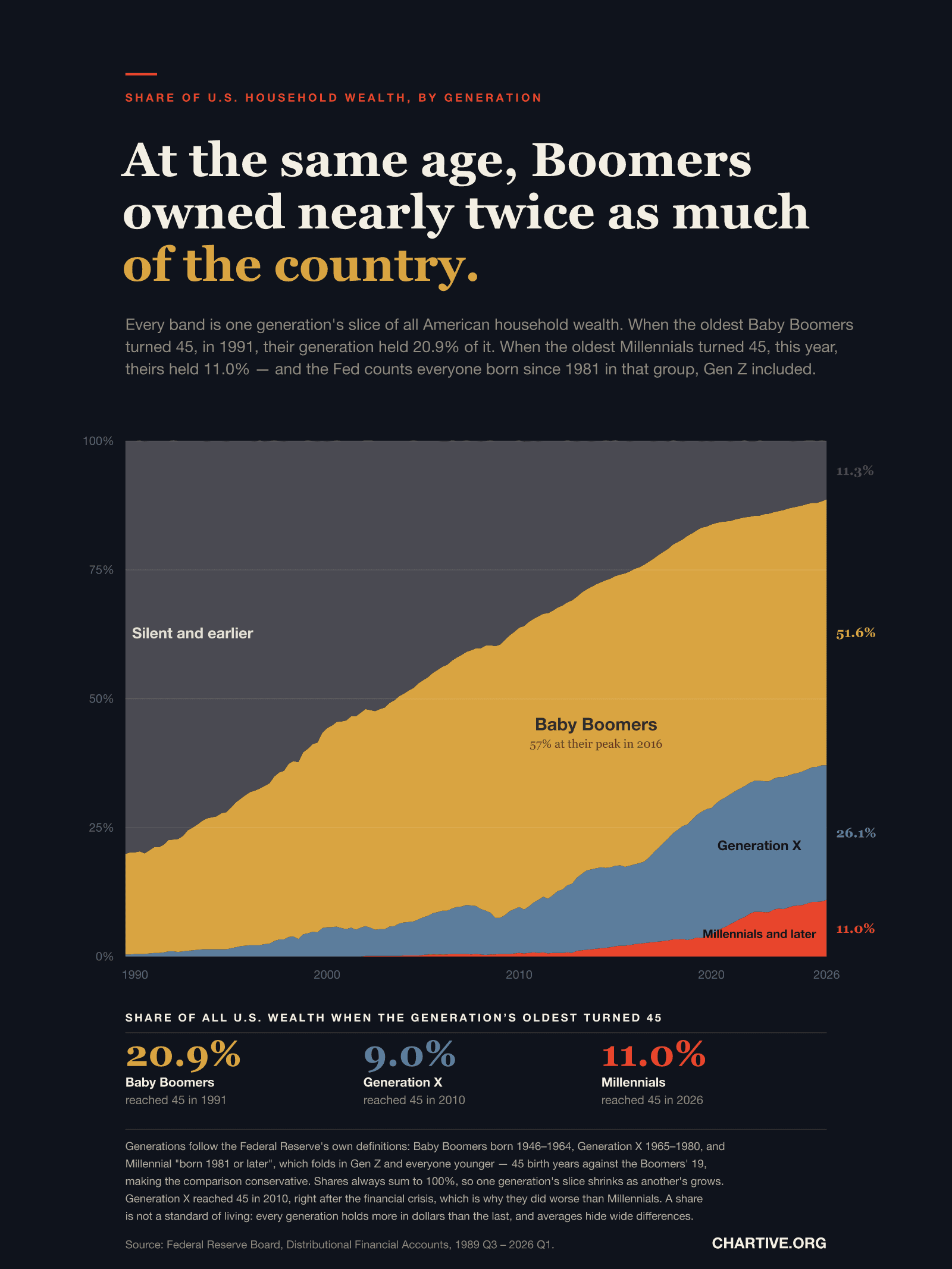
At the same age, Boomers owned nearly twice as much of the country
When the oldest Baby Boomers turned 45, in 1991, their generation held 20.9% of all US household wealth. When the oldest Millennials turned 45, in 2026, theirs held 11.0%.
Chartive Editorial
Climate
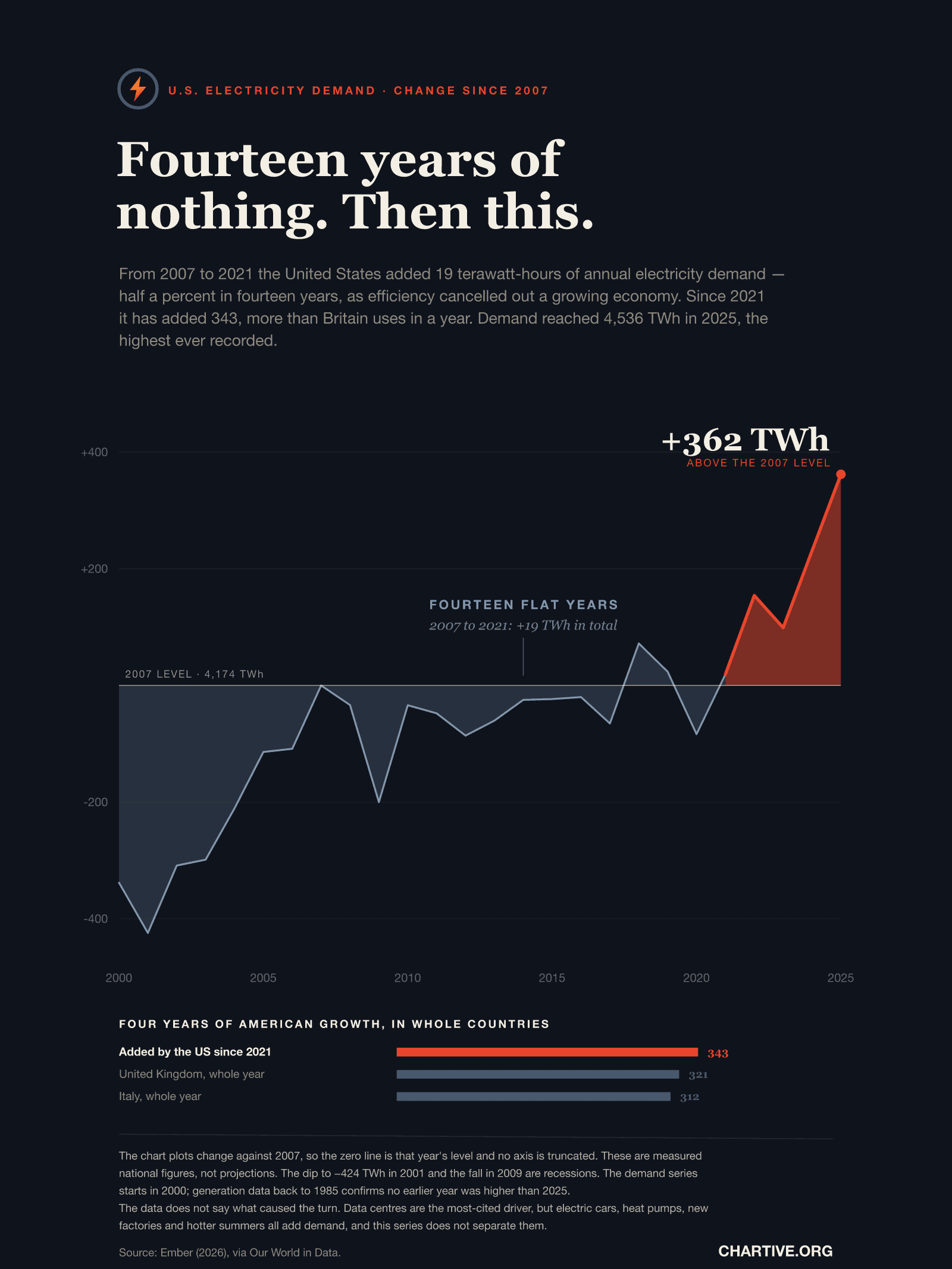
Fourteen years of nothing. Then this.
From 2007 to 2021 the United States added 19 terawatt-hours of annual electricity demand — half a percent in fourteen years. Since 2021 it has added 343, more than Britain uses in a year.
Chartive Editorial
Demographics
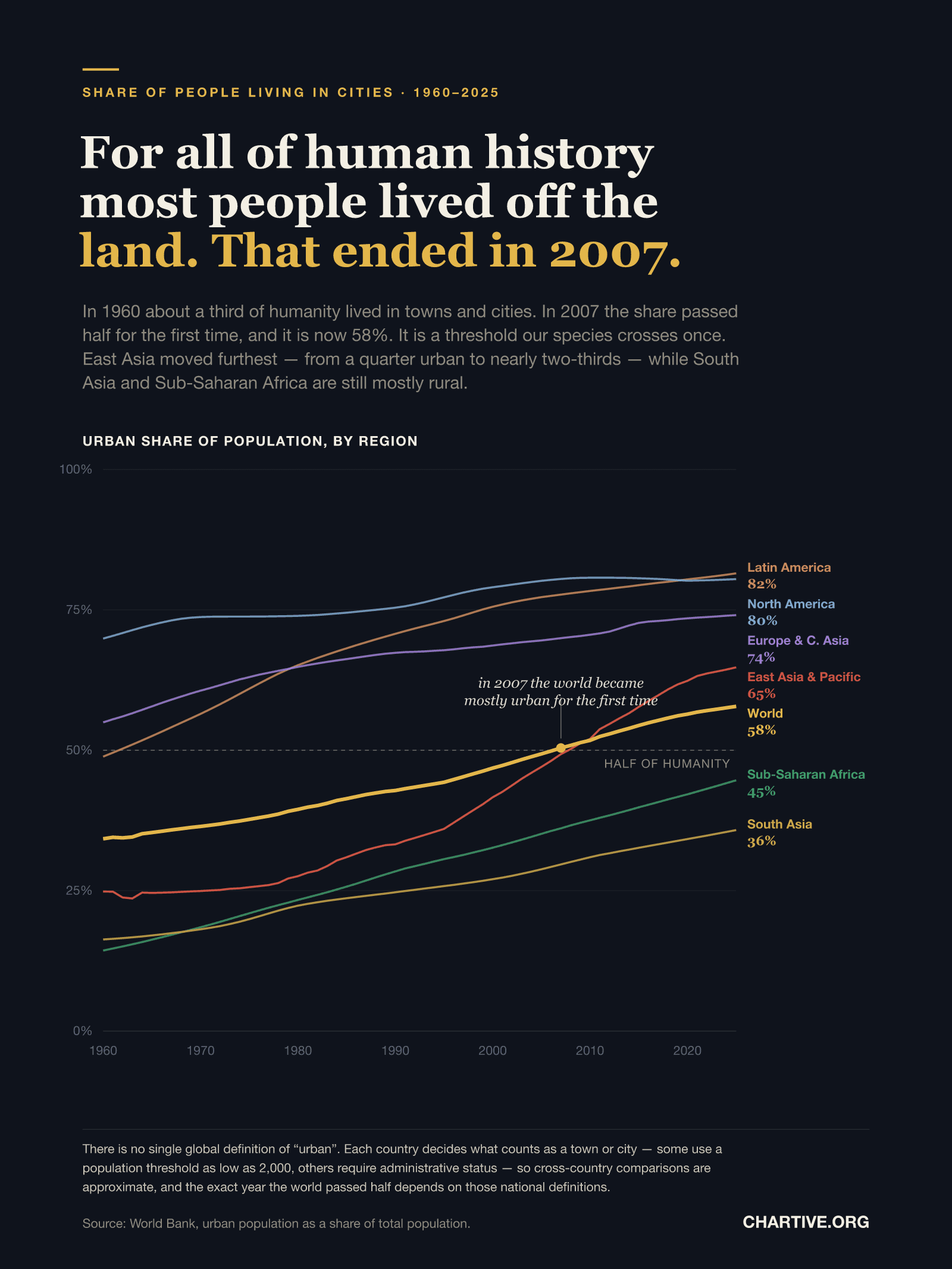
For all of human history most people lived off the land. That ended in 2007.
In 1960 about a third of humanity lived in towns and cities. In 2007 the share passed half for the first time, and it is now 58%. It is a threshold our species crosses only once.
Chartive Editorial
Technology
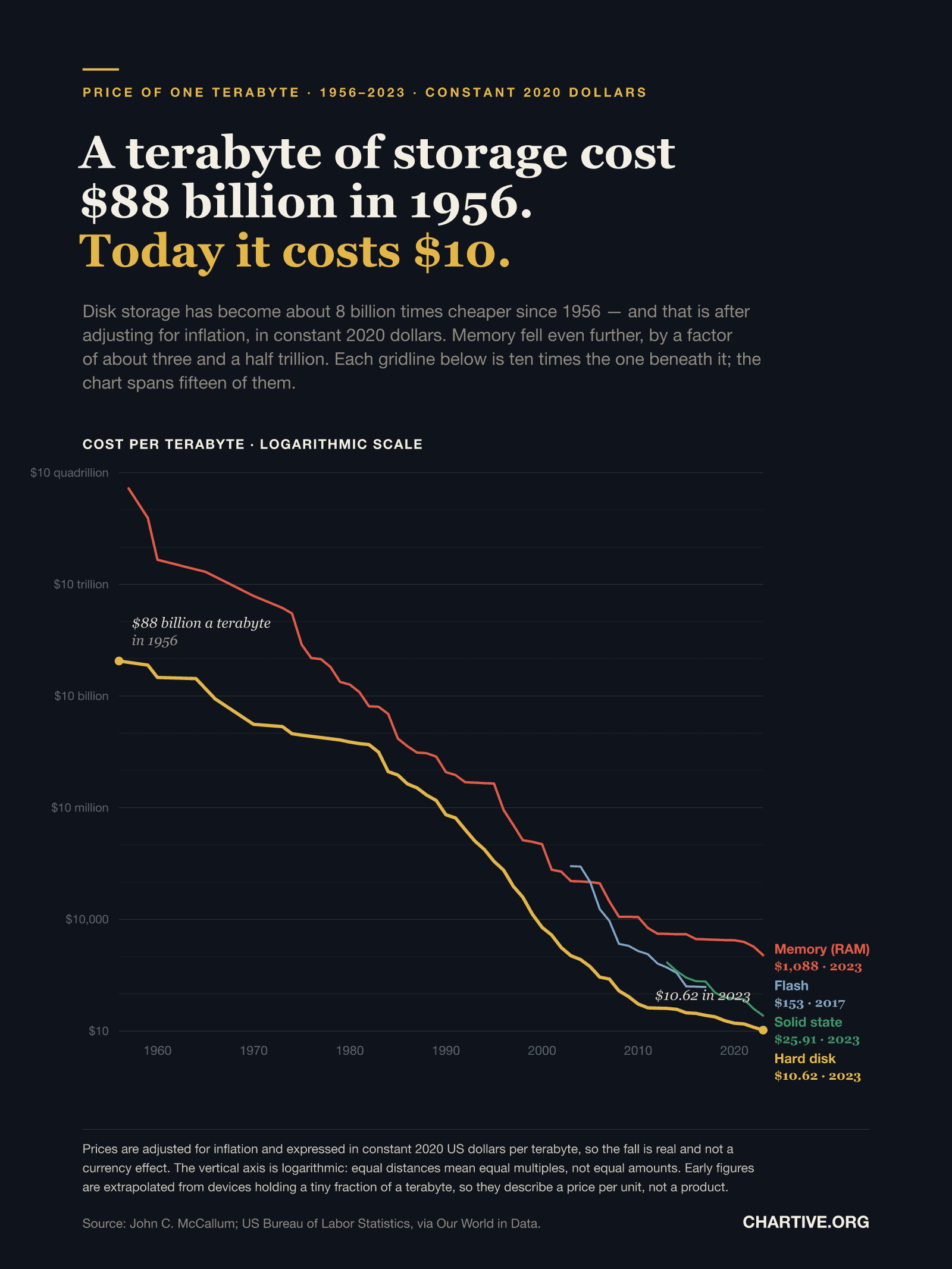
A terabyte of storage cost $88 billion in 1956. Today it costs $10.
Disk storage has become about 8 billion times cheaper since 1956 — and that is after adjusting for inflation, in constant 2020 dollars. Computer memory fell even further, by a factor of about three and a half trillion.
Chartive Editorial
Health
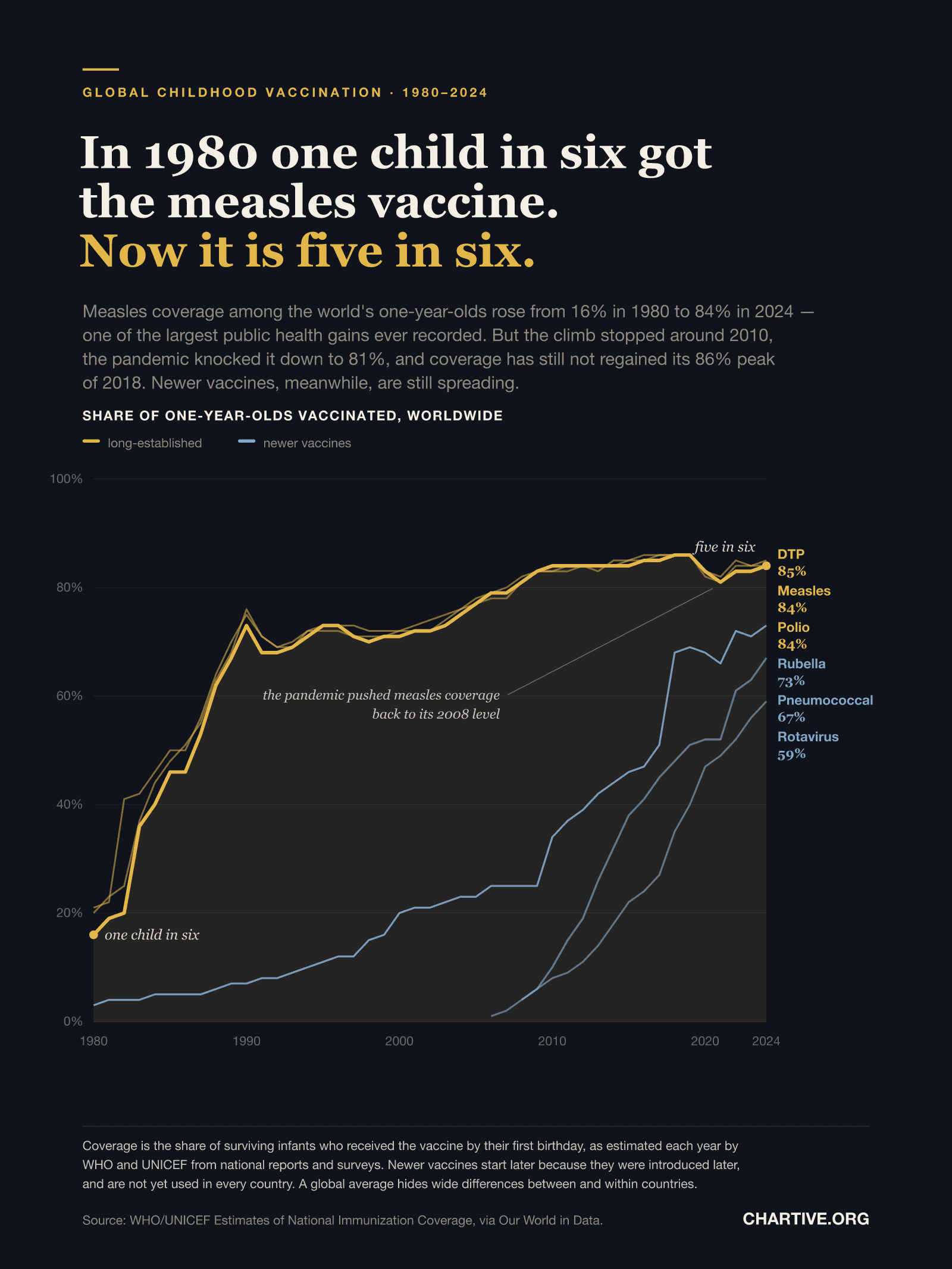
In 1980 one child in six got the measles vaccine. Now it is five in six.
Global measles coverage among one-year-olds rose from 16% in 1980 to 84% in 2024 — one of the largest public health gains ever recorded. But the climb stopped around 2010, and coverage has still not regained its 86% peak of 2018.
Chartive Editorial
Economy
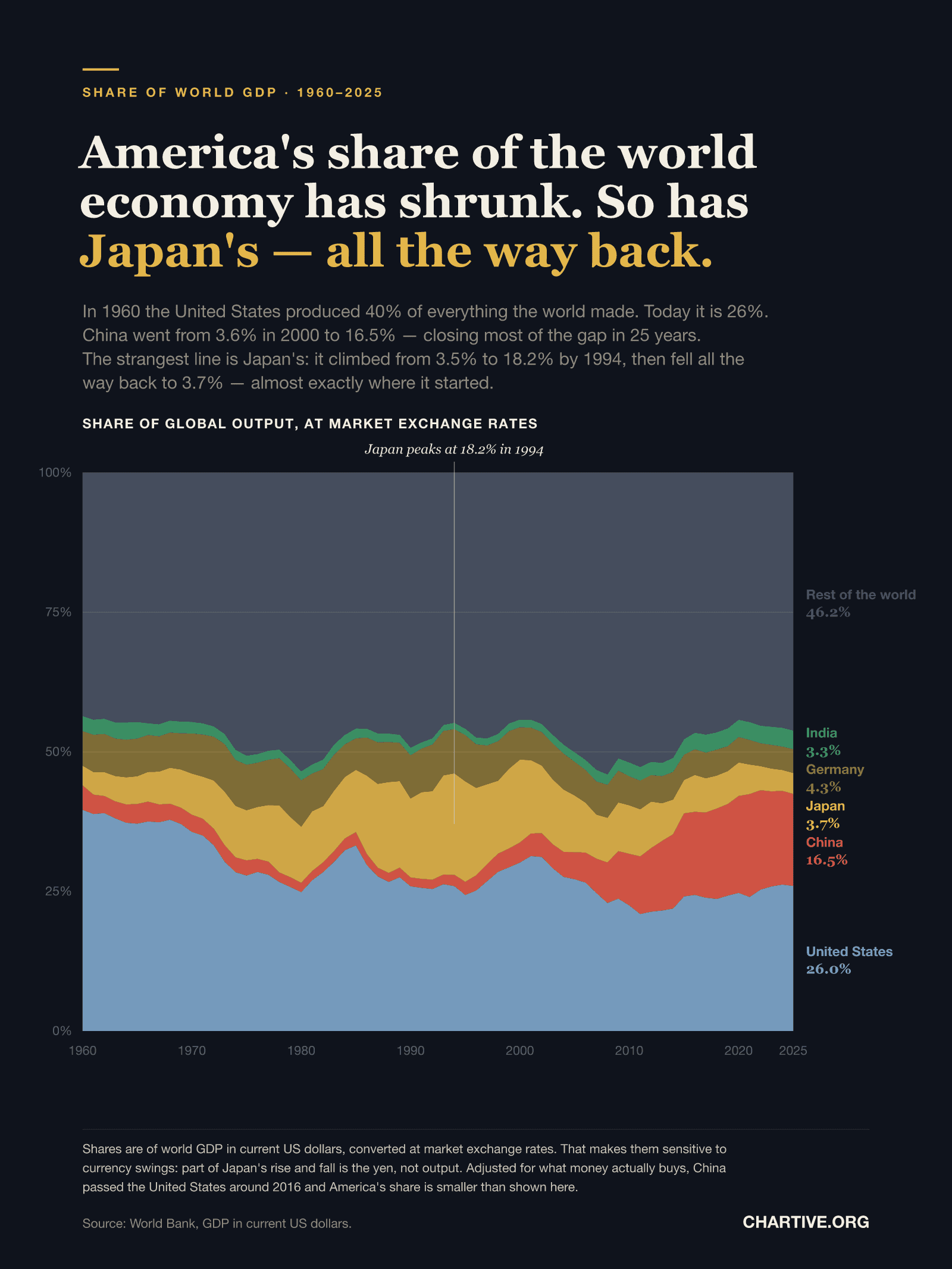
America's share of the world economy has shrunk. So has Japan's — all the way back.
In 1960 the United States produced 40% of everything the world made; today it is 26%. China went from 3.6% in 2000 to 16.5%. Japan climbed to 18.2% by 1994 and then fell back to 3.7% — almost exactly where it started.
Chartive Editorial
Society
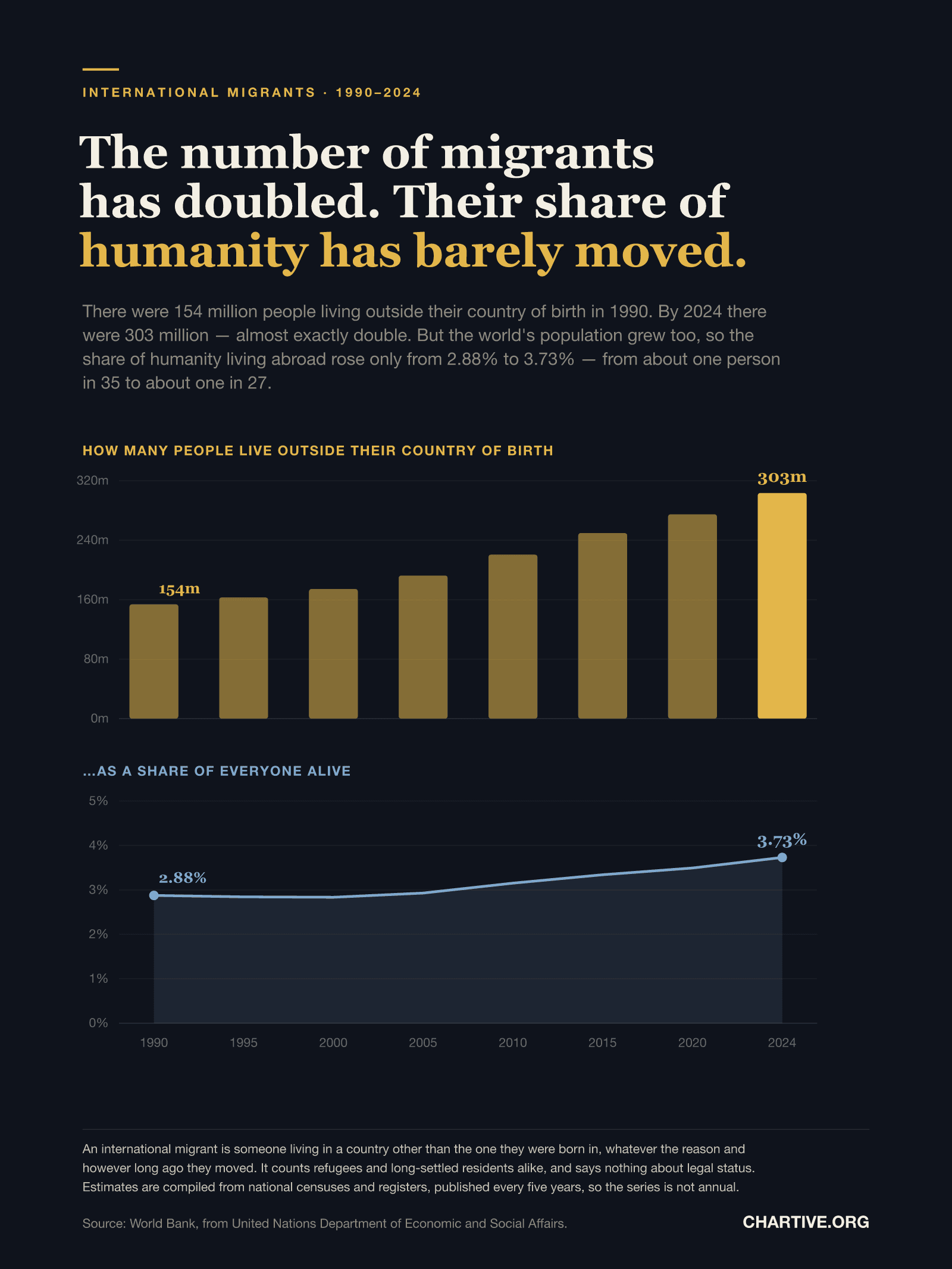
The number of migrants has doubled. Their share of humanity has barely moved.
There were 154 million people living outside their country of birth in 1990. By 2024 there were 303 million — almost exactly double. But because the world's population grew too, the share living abroad rose only from 2.88% to 3.73%.
Chartive Editorial
Economy
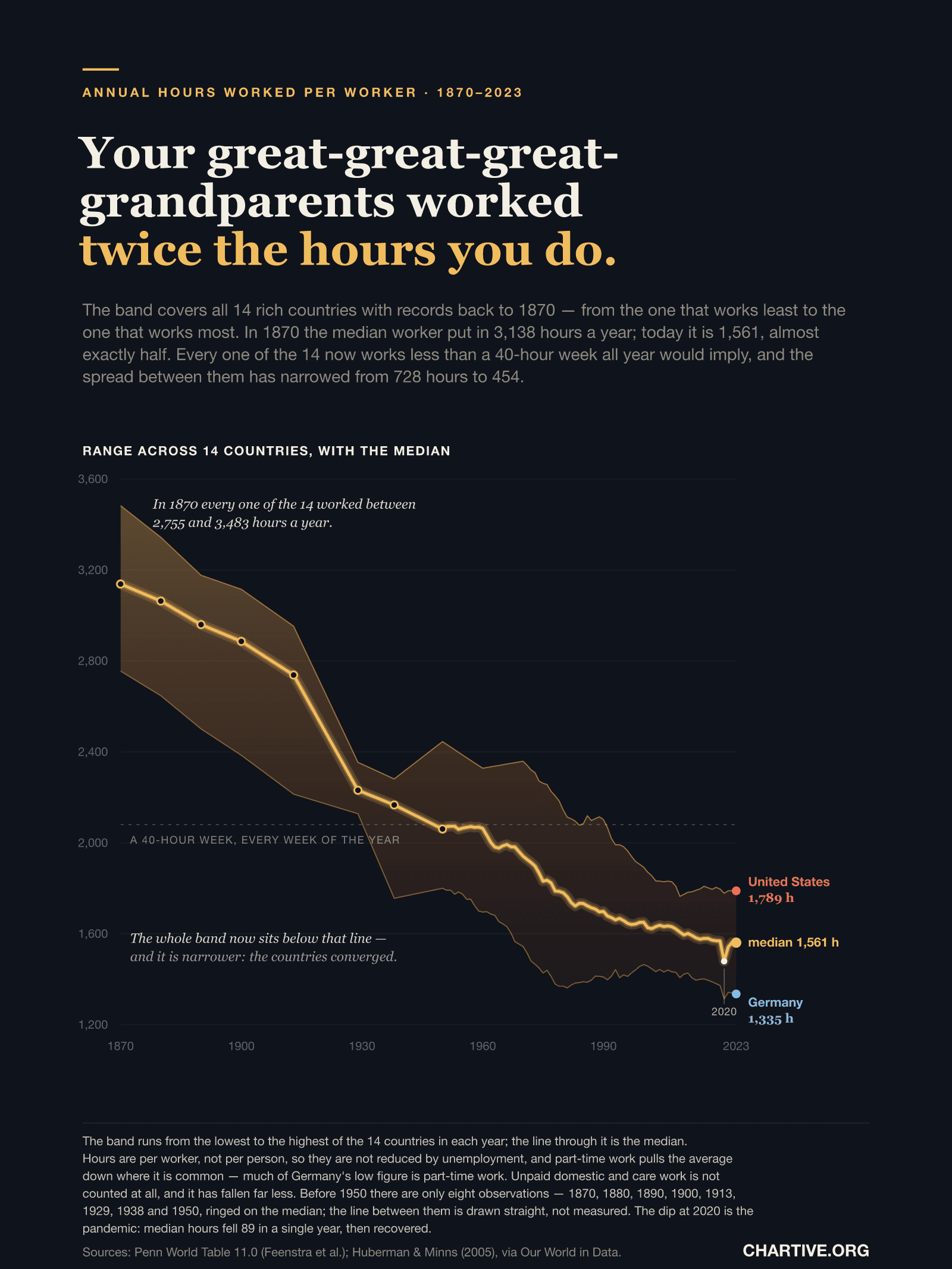
Your great-great-great-grandparents worked twice the hours you do
Across the 14 rich countries with records back to 1870, the median worker put in 3,138 hours a year. Today it is 1,561 — almost exactly half. Every one of them now works less than a 40-hour week all year would imply.
Chartive Editorial
Health
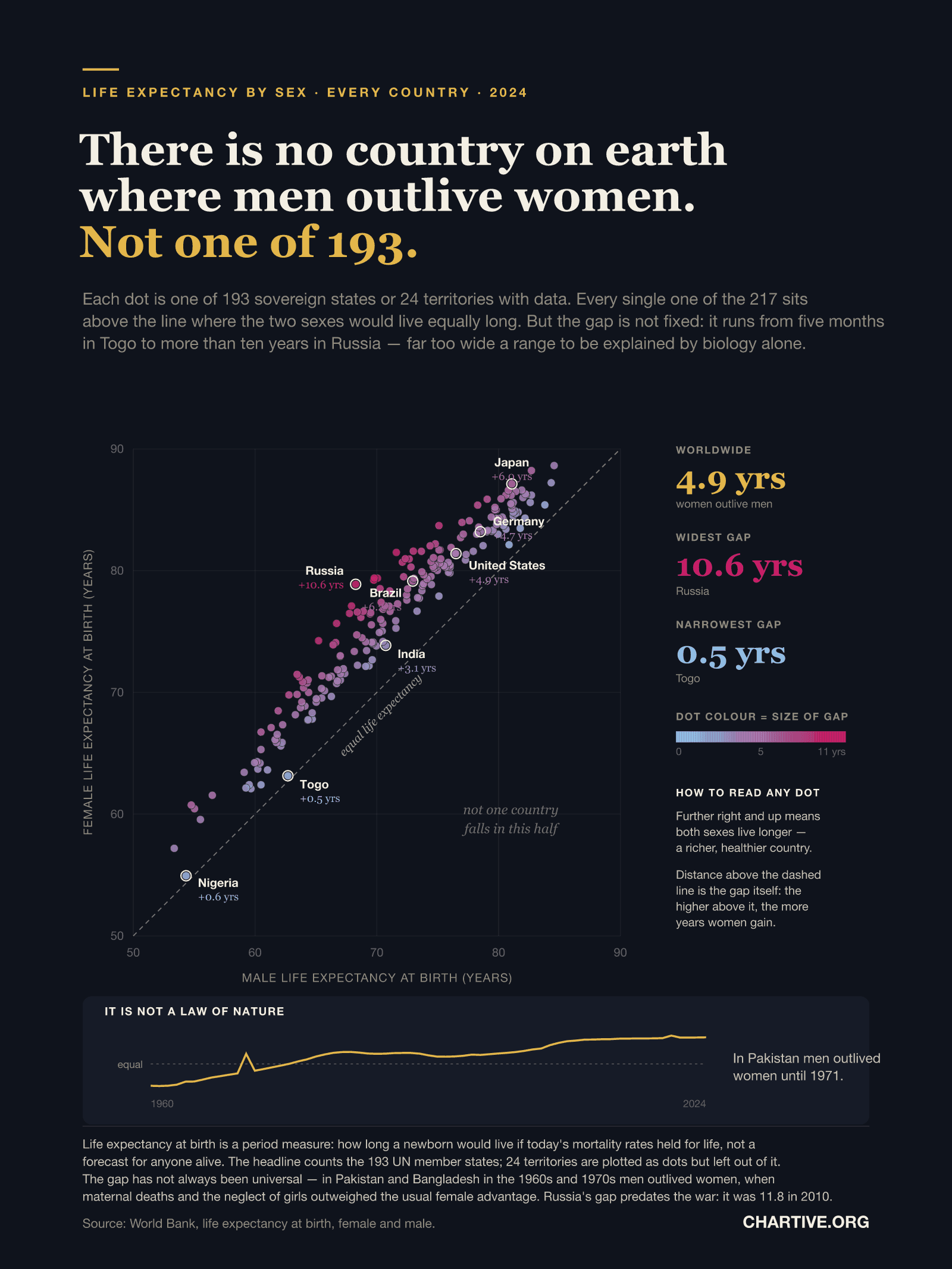
There is no country on earth where men outlive women
Each dot is one of 193 sovereign states or 24 territories with data. Every single one of the 217 sits above the line where the two sexes would live equally long — but the gap runs from five months in Togo to more than ten years in Russia.
Chartive Editorial
Technology
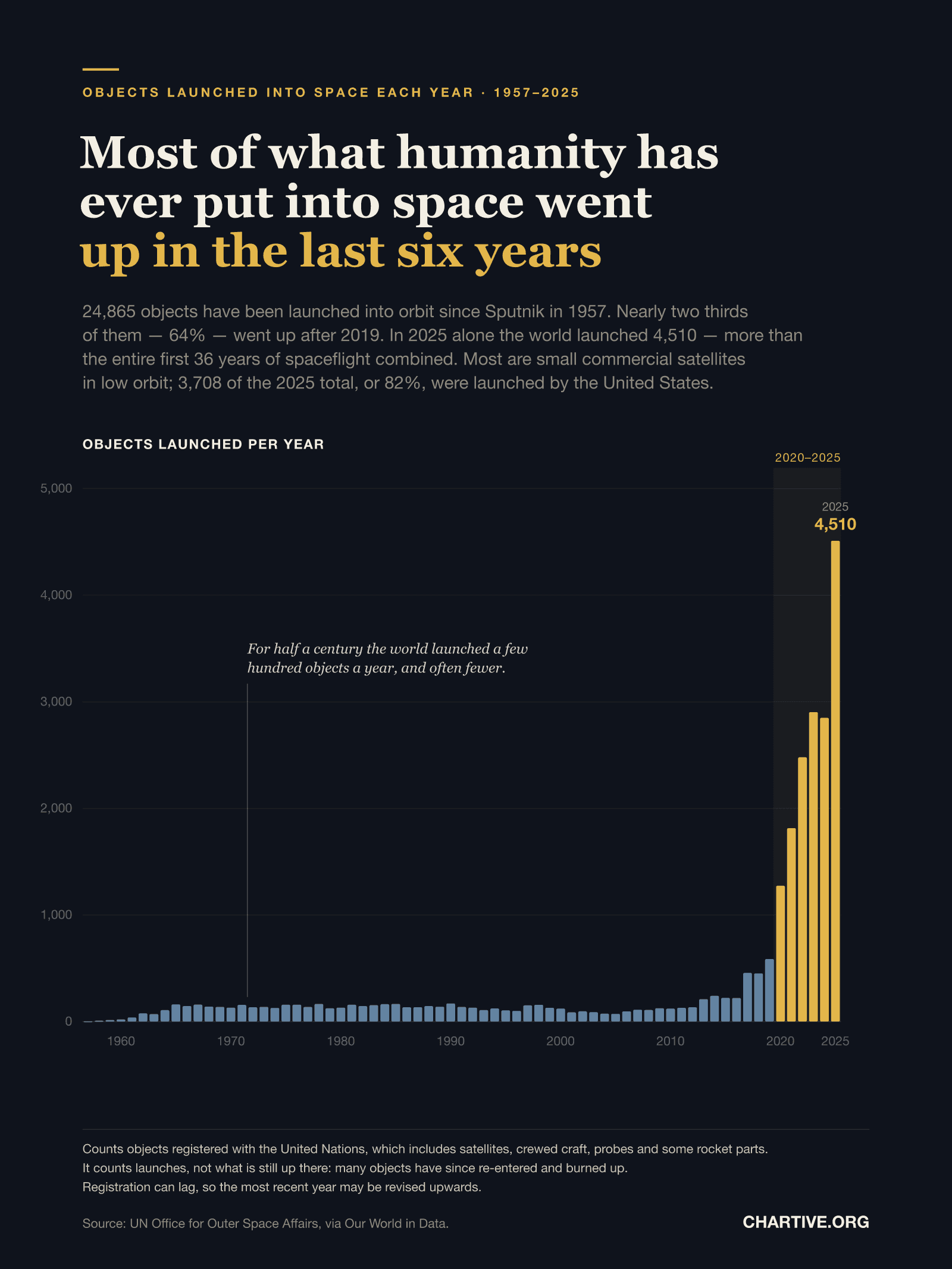
Most of what humanity has ever put into space went up in the last six years
24,865 objects have been launched into orbit since Sputnik in 1957. Nearly two thirds of them went up after 2019, and 2025 alone accounted for 4,510 — more than the entire first 36 years of spaceflight combined.
Chartive Editorial
Climate
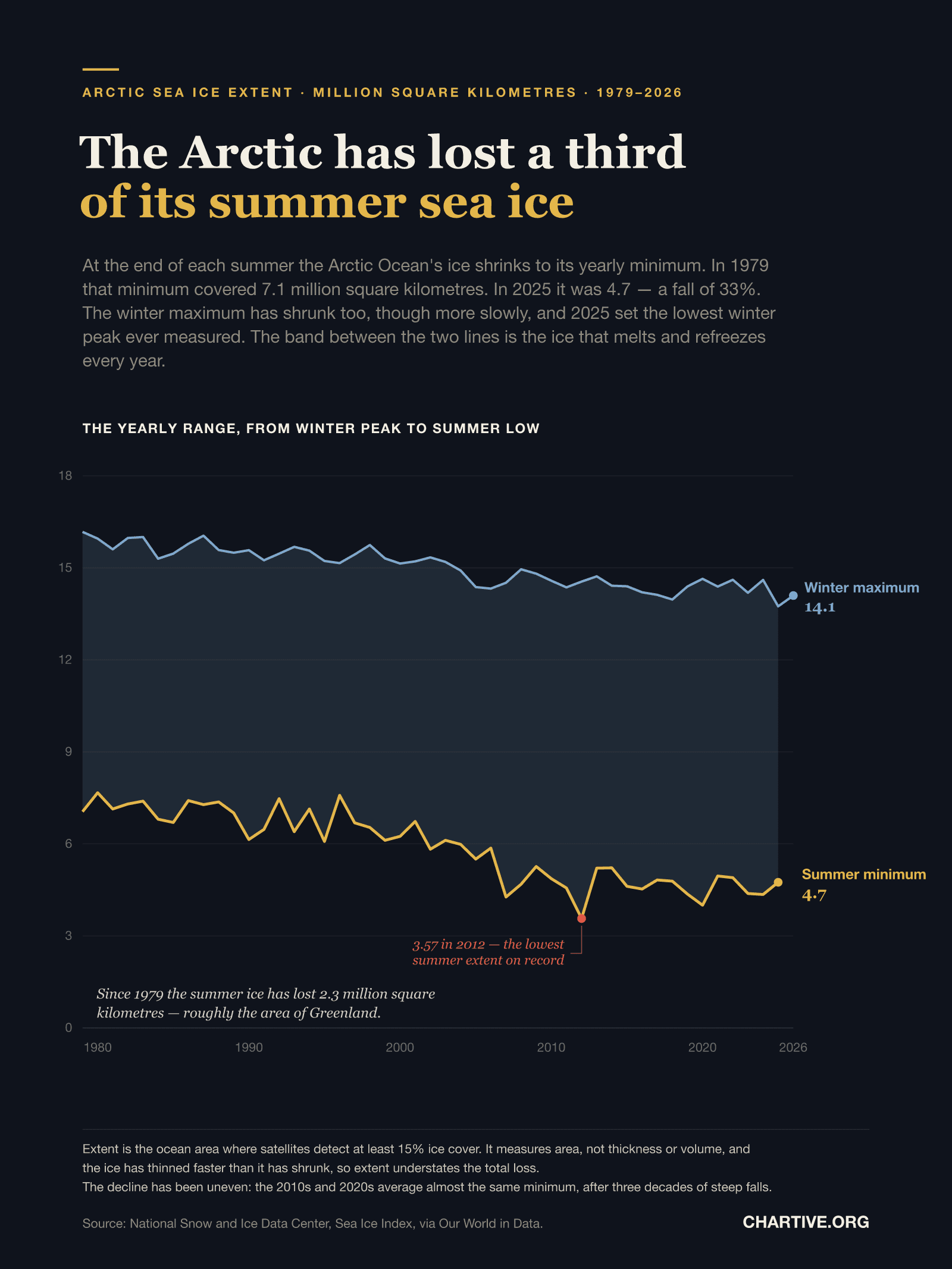
The Arctic has lost a third of its summer sea ice
At its yearly minimum in 1979, Arctic sea ice covered 7.1 million square kilometres. In 2025 it was 4.7 — a fall of 33%, and a loss roughly the area of Greenland.
Chartive Editorial
Health
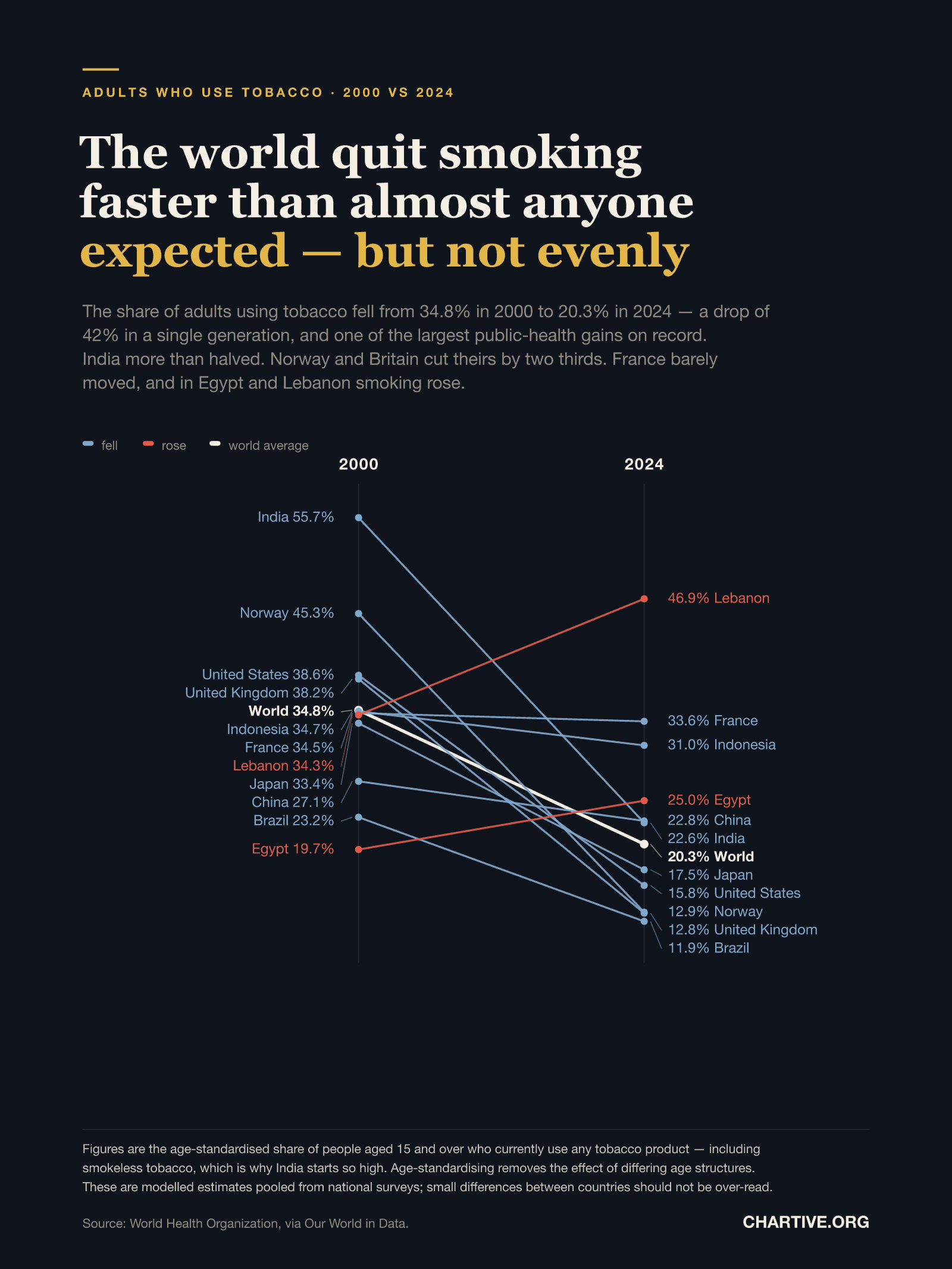
The world quit smoking faster than almost anyone expected — but not evenly
The share of adults using tobacco fell from 34.8% in 2000 to 20.3% in 2024 — a drop of 42% in a single generation. India more than halved, Norway and Britain cut theirs by two thirds, while France barely moved and smoking rose in Egypt and Lebanon.
Chartive Editorial
Economy
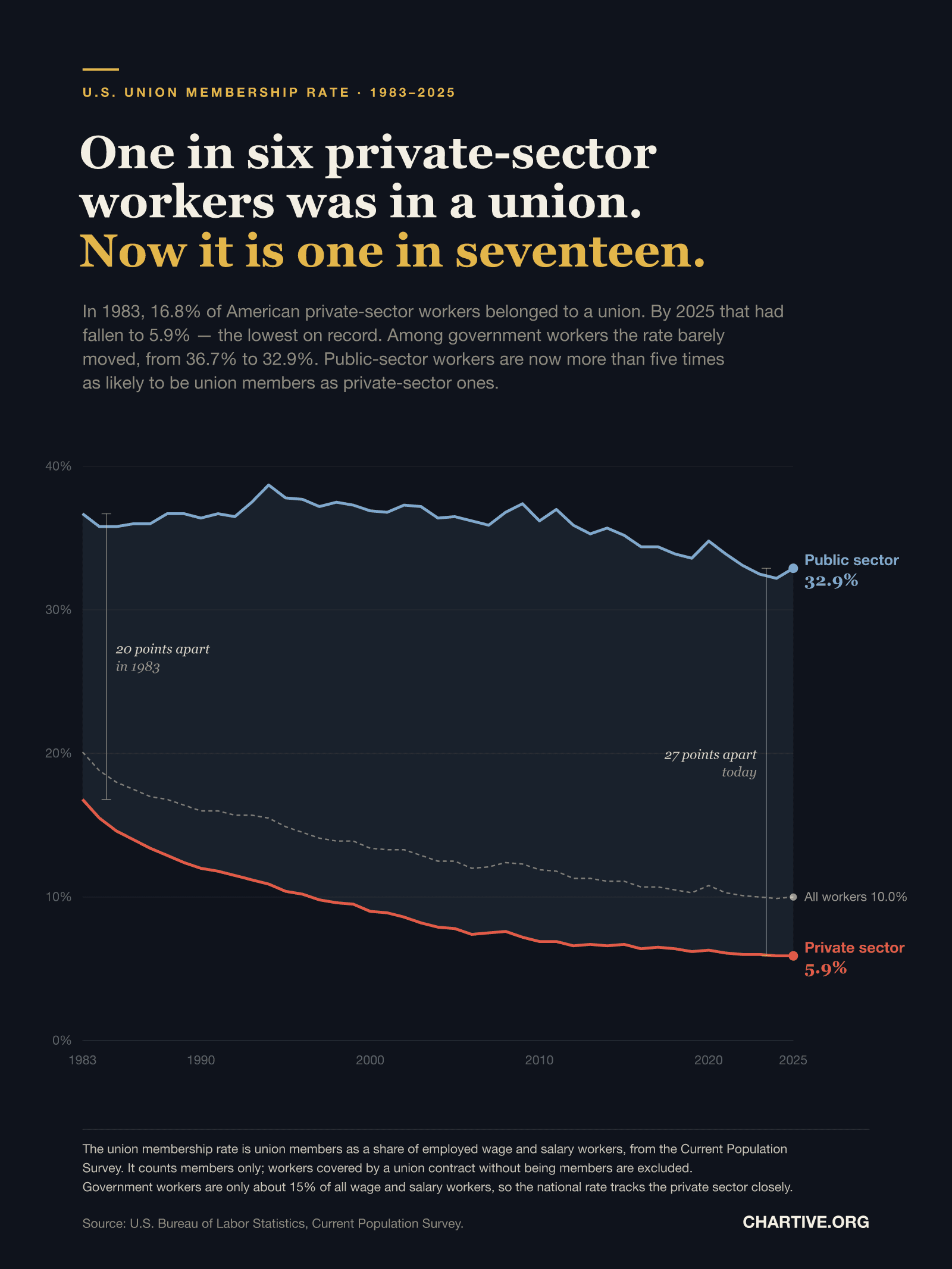
One in six private-sector workers was in a union. Now it is one in seventeen.
In 1983, 16.8% of American private-sector workers belonged to a union. By 2025 that had fallen to 5.9% — the lowest on record — while the rate among government workers barely moved.
Chartive Editorial
Economy
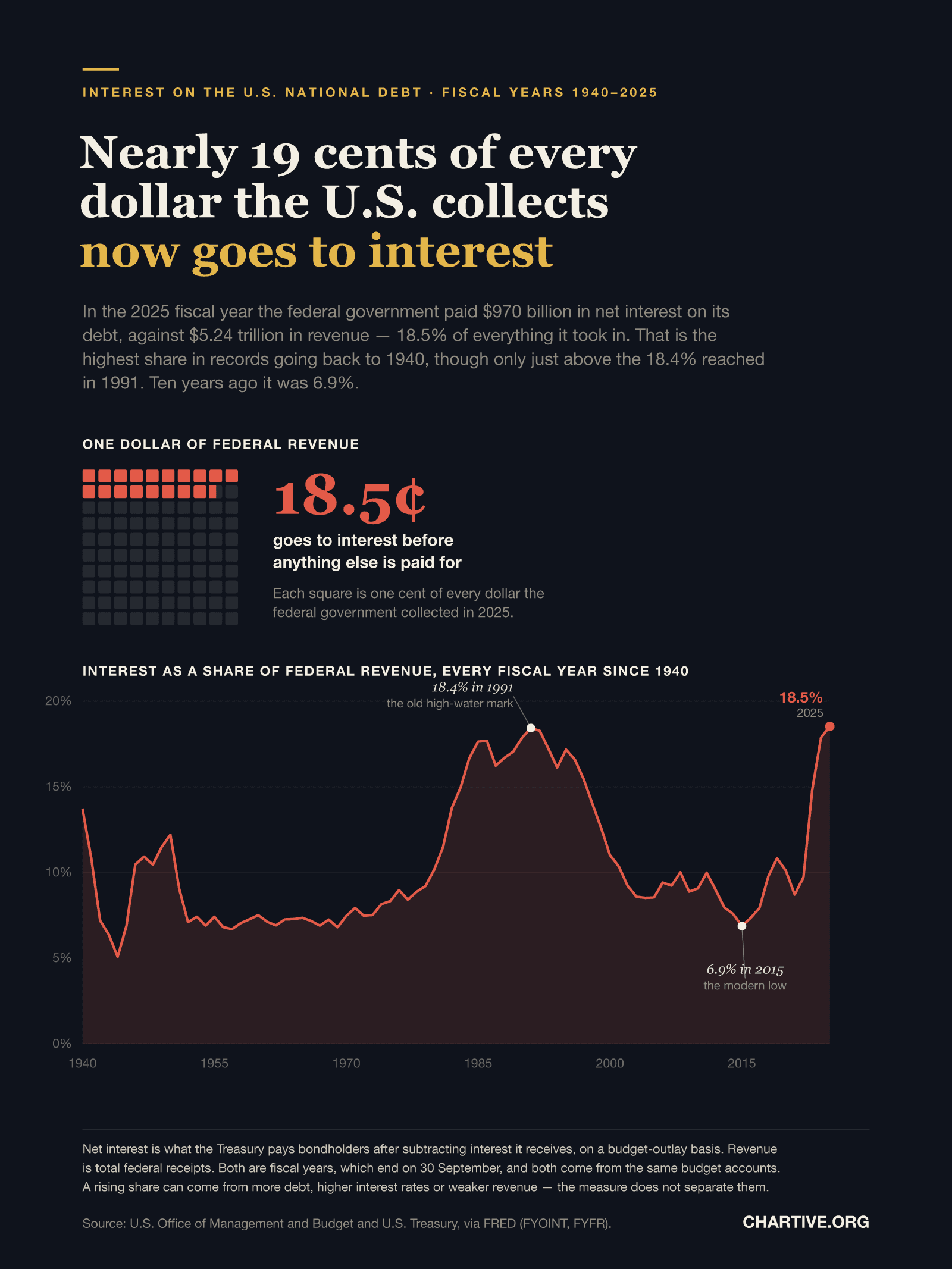
Nearly 19 cents of every dollar the U.S. collects now goes to interest
In the 2025 fiscal year the federal government paid $970 billion in net interest on its debt, against $5.24 trillion in revenue — 18.5% of everything it took in, the highest share in records going back to 1940.
Chartive Editorial
Health
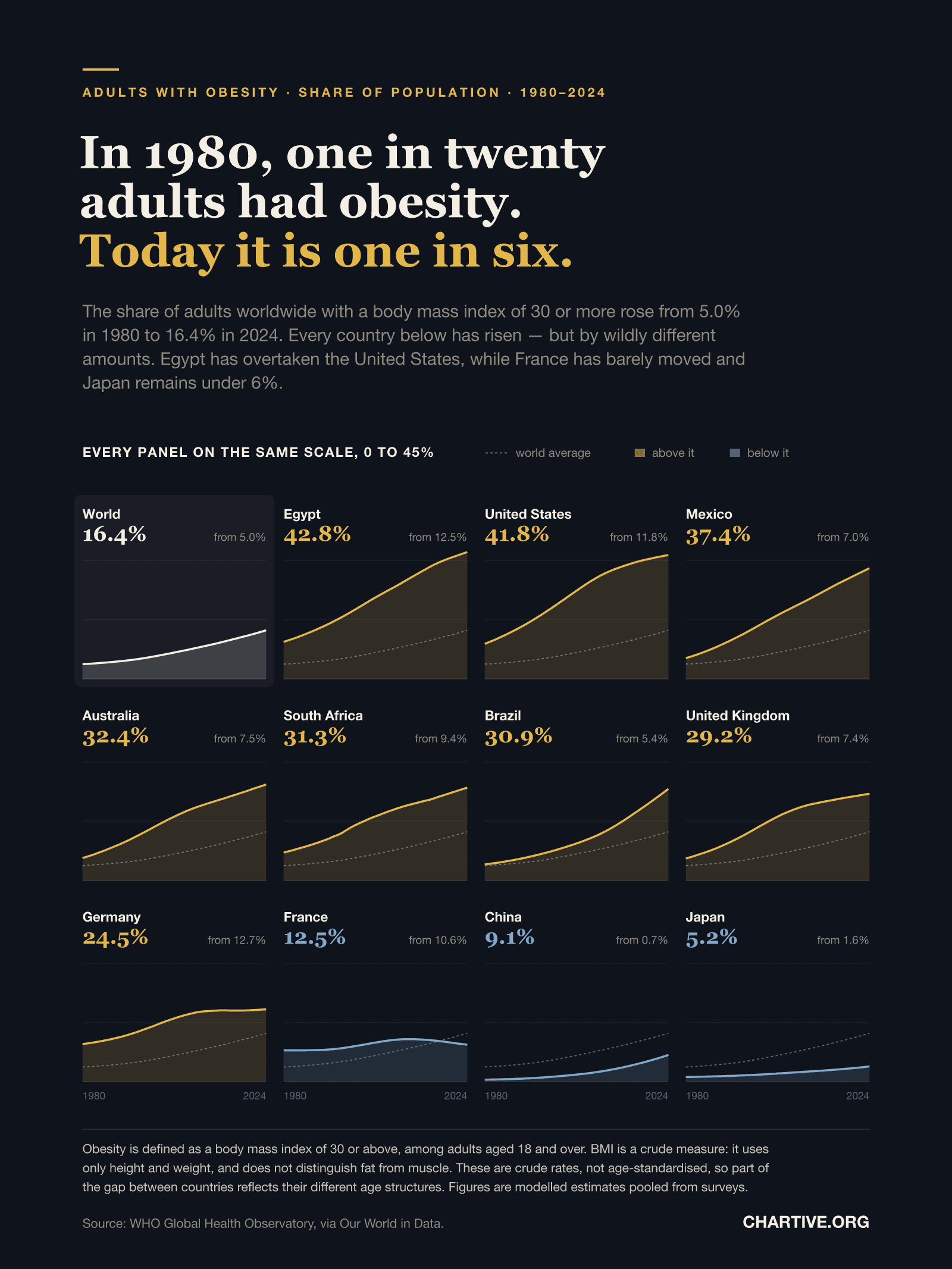
In 1980, one in twenty adults had obesity. Today it is one in six.
The share of adults worldwide with a body mass index of 30 or more rose from 5.0% in 1980 to 16.4% in 2024. Every country has risen — but by wildly different amounts.
Chartive Editorial
Demographics
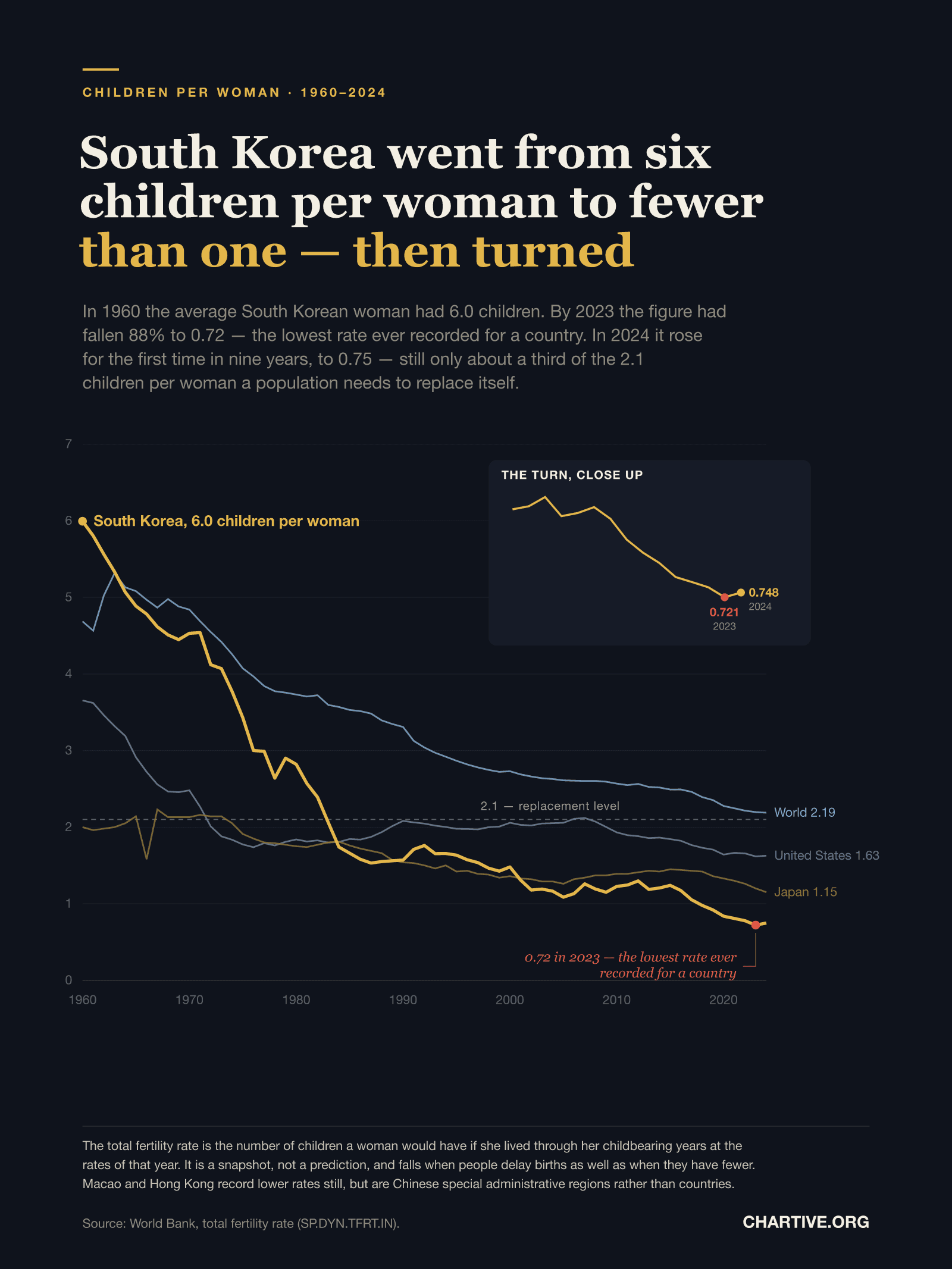
South Korea went from six children per woman to fewer than one — then turned
In 1960 the average South Korean woman had 6.0 children. By 2023 the figure had fallen 88% to 0.72 — the lowest rate ever recorded for a country. In 2024 it rose for the first time in nine years.
Chartive Editorial
Climate
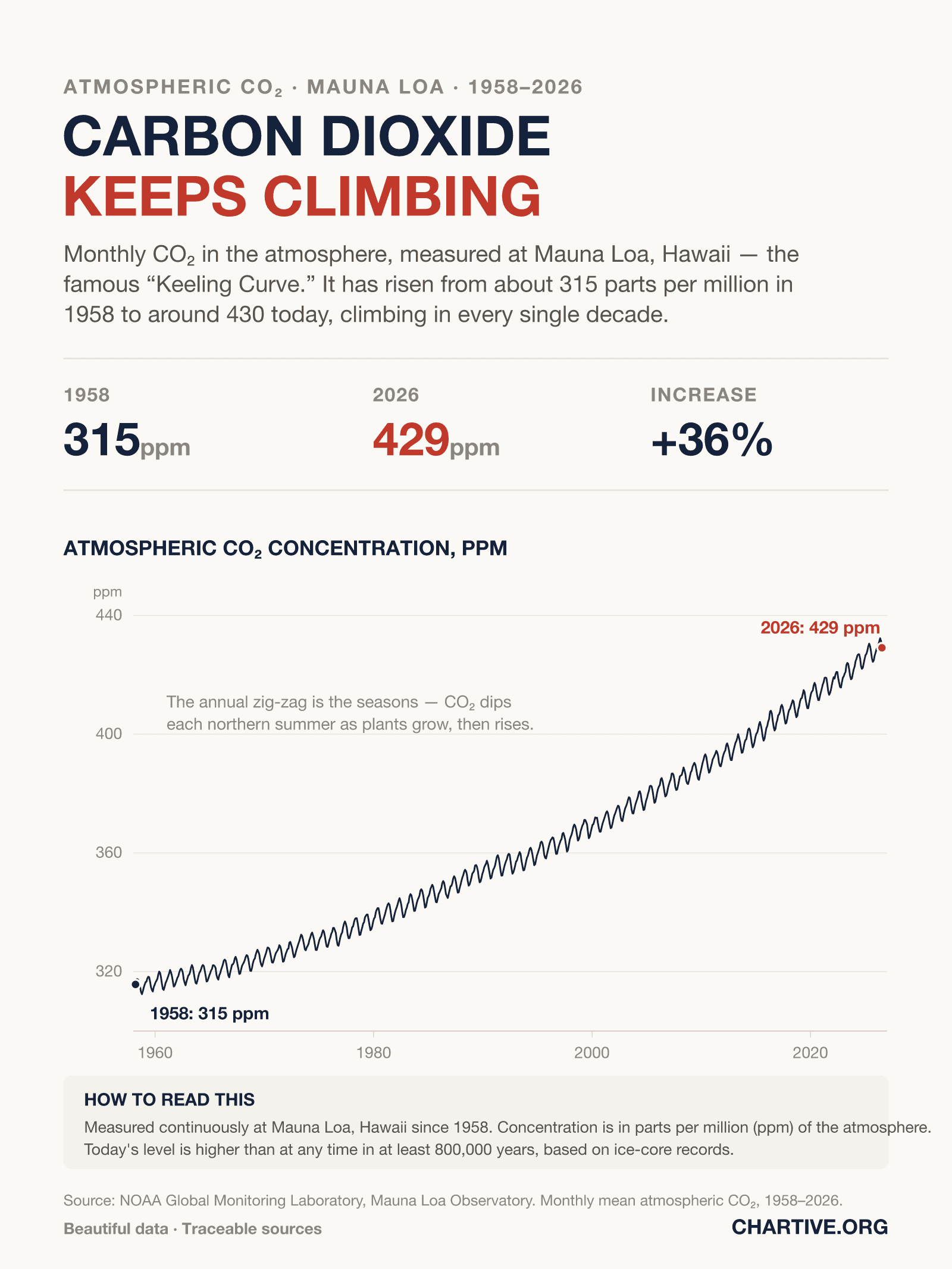
Carbon dioxide keeps climbing
Monthly CO₂ in the atmosphere, measured at Mauna Loa, Hawaii — the famous “Keeling Curve.” It has risen from about 315 parts per million in 1958 to around 430 today, climbing in every single decade.
Daniel Okafor
Society
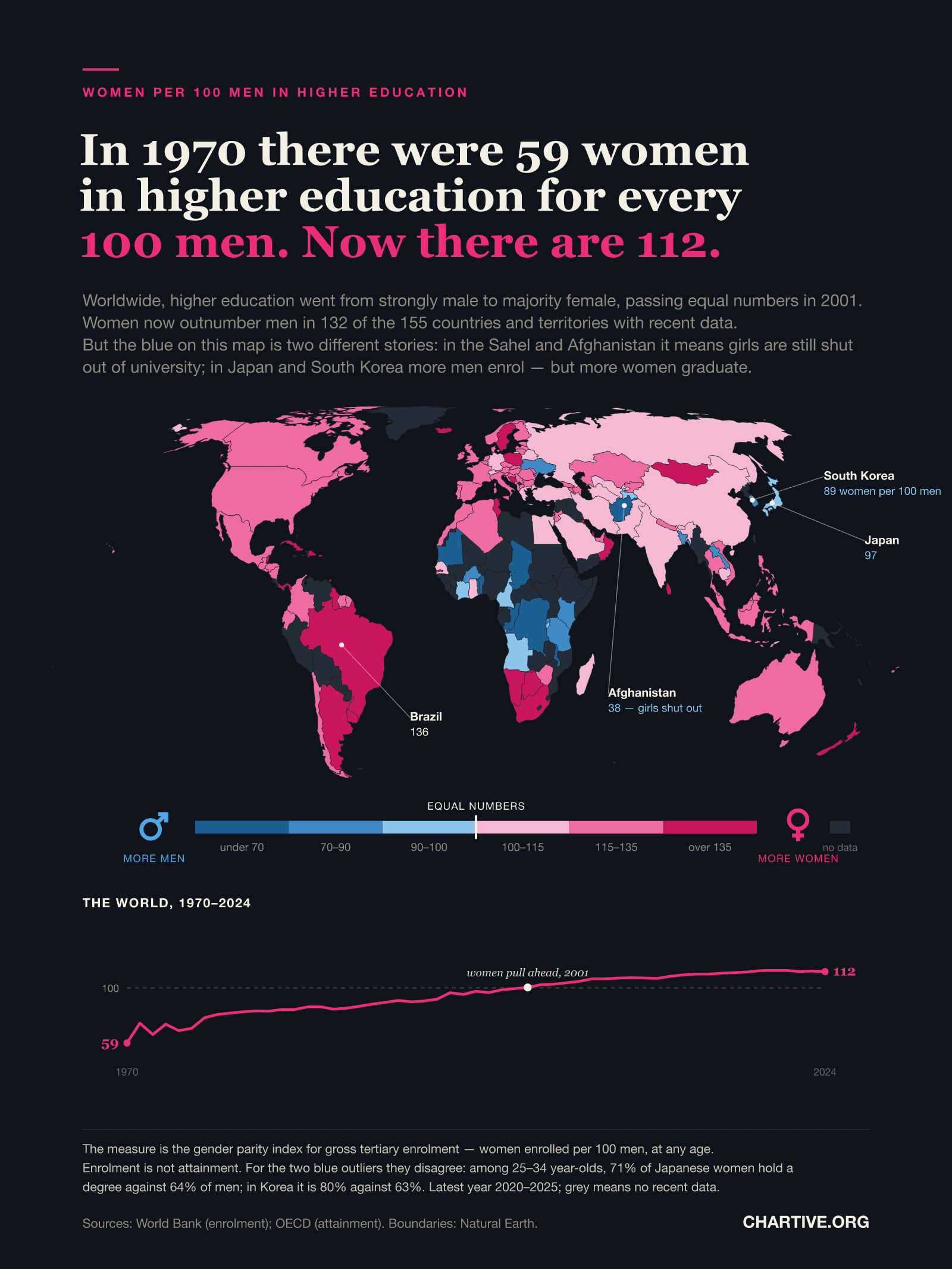
In 1970 there were 59 women in higher education for every 100 men. Now there are 112.
Worldwide, higher education went from strongly male to majority female, passing equal numbers in 2001. Women now outnumber men in 132 of the 155 countries and territories with recent data — but the exceptions are two very different stories.
Chartive Editorial
Economy
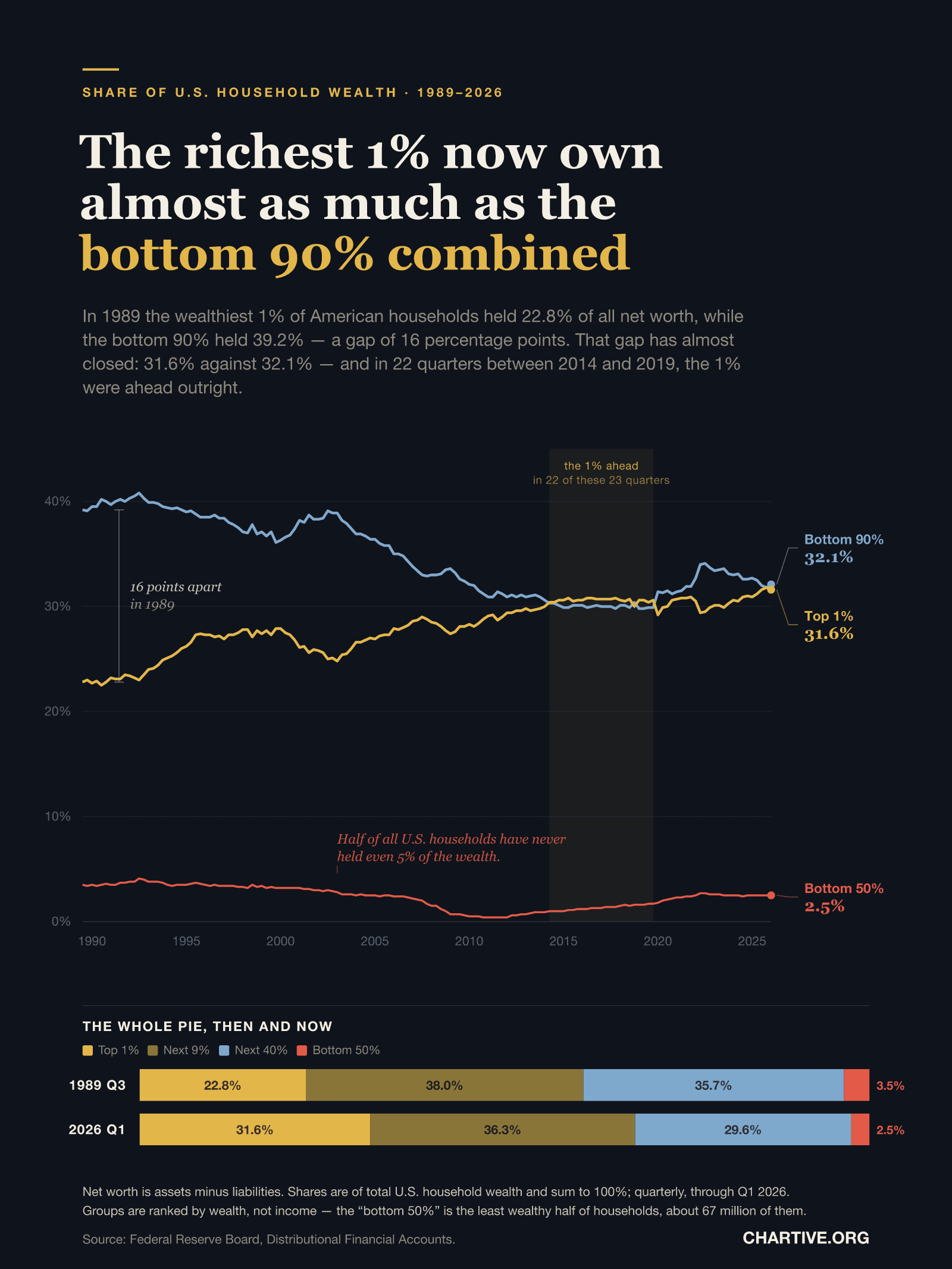
The richest 1% now own almost as much as the bottom 90% combined
In 1989 the wealthiest 1% of American households held 22.8% of all net worth and the bottom 90% held 39.2% — a gap of 16 percentage points. That gap has almost closed: 31.6% against 32.1%.
Chartive Editorial
Technology
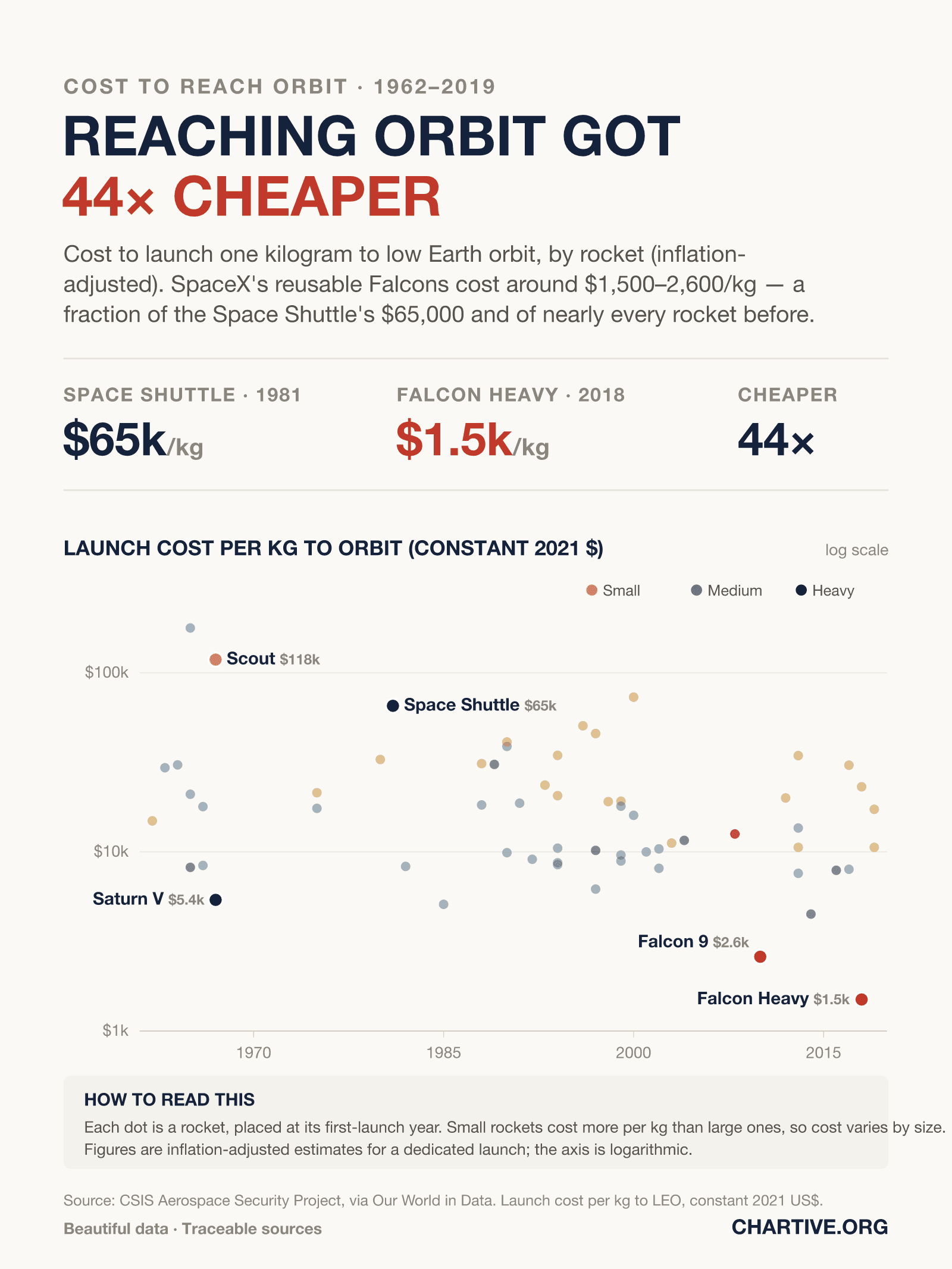
Reaching orbit got 44× cheaper
Cost to launch one kilogram to low Earth orbit, by rocket (inflation-adjusted). SpaceX's reusable Falcons cost around $1,500–2,600/kg — a fraction of the Space Shuttle's $65,000 and of nearly every rocket before them.
Chartive Editorial
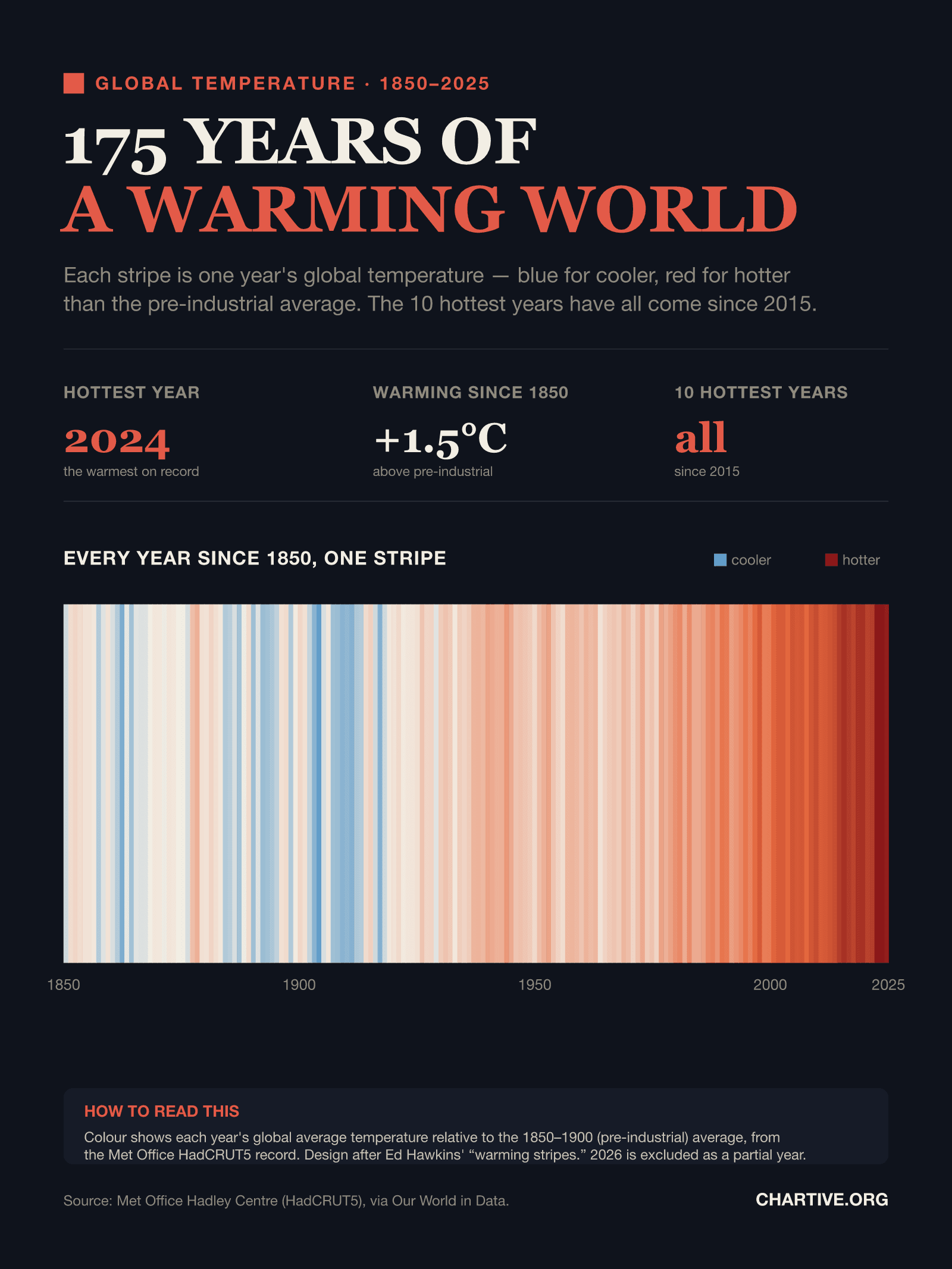
Climate
175 years of a warming world
Each stripe is one year's global temperature from 1850 to 2025 — blue for cooler, red for hotter than the pre-industrial average. The ten hottest years on record have all come since 2015.
Chartive Editorial
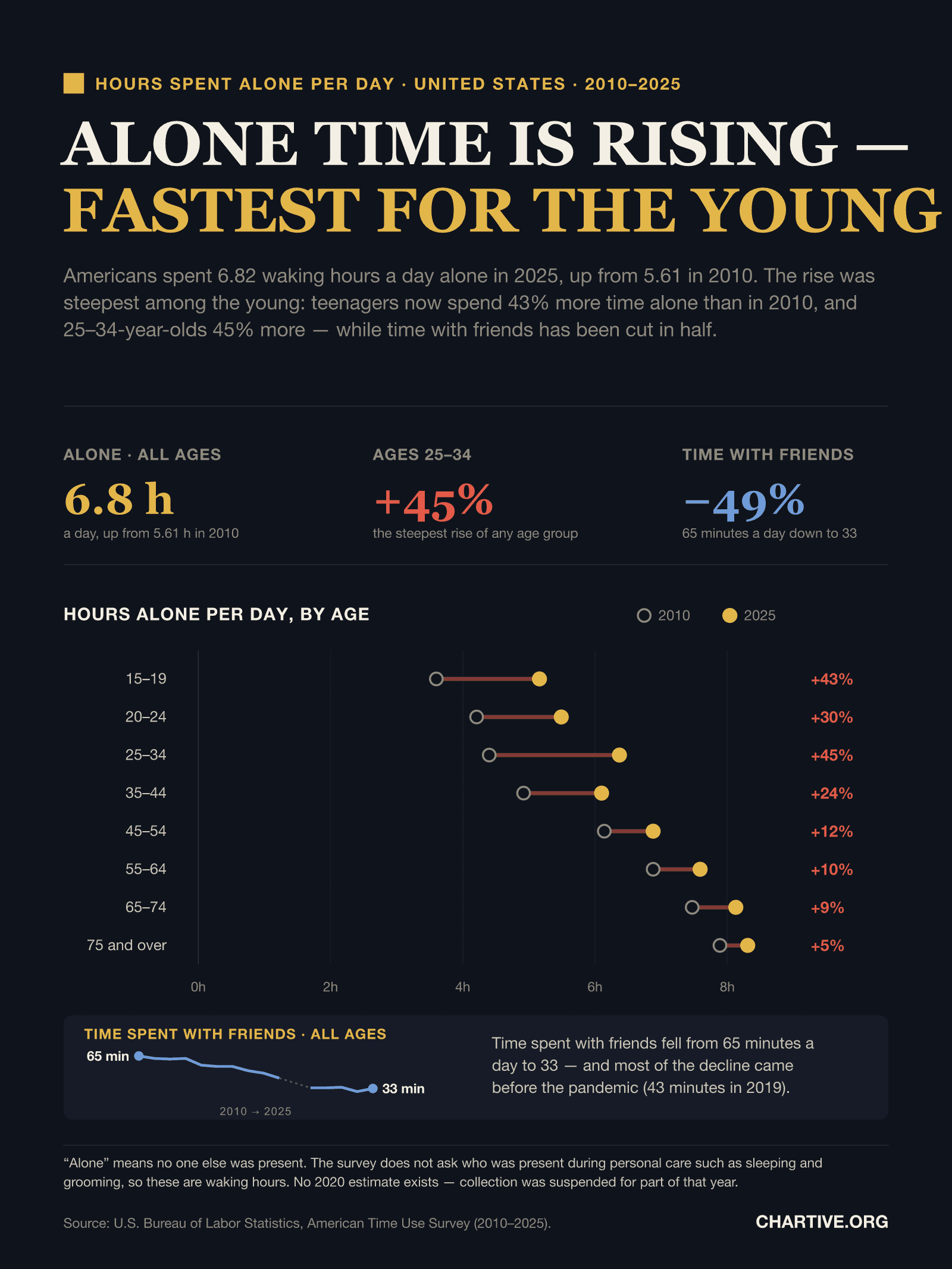
Society
Alone time is rising — fastest for the young
Americans spent 6.82 waking hours a day alone in 2025, up from 5.61 in 2010. Teenagers now spend 43% more time alone than they did in 2010, and 25–34-year-olds 45% more — while time with friends has been cut in half.
Chartive Editorial
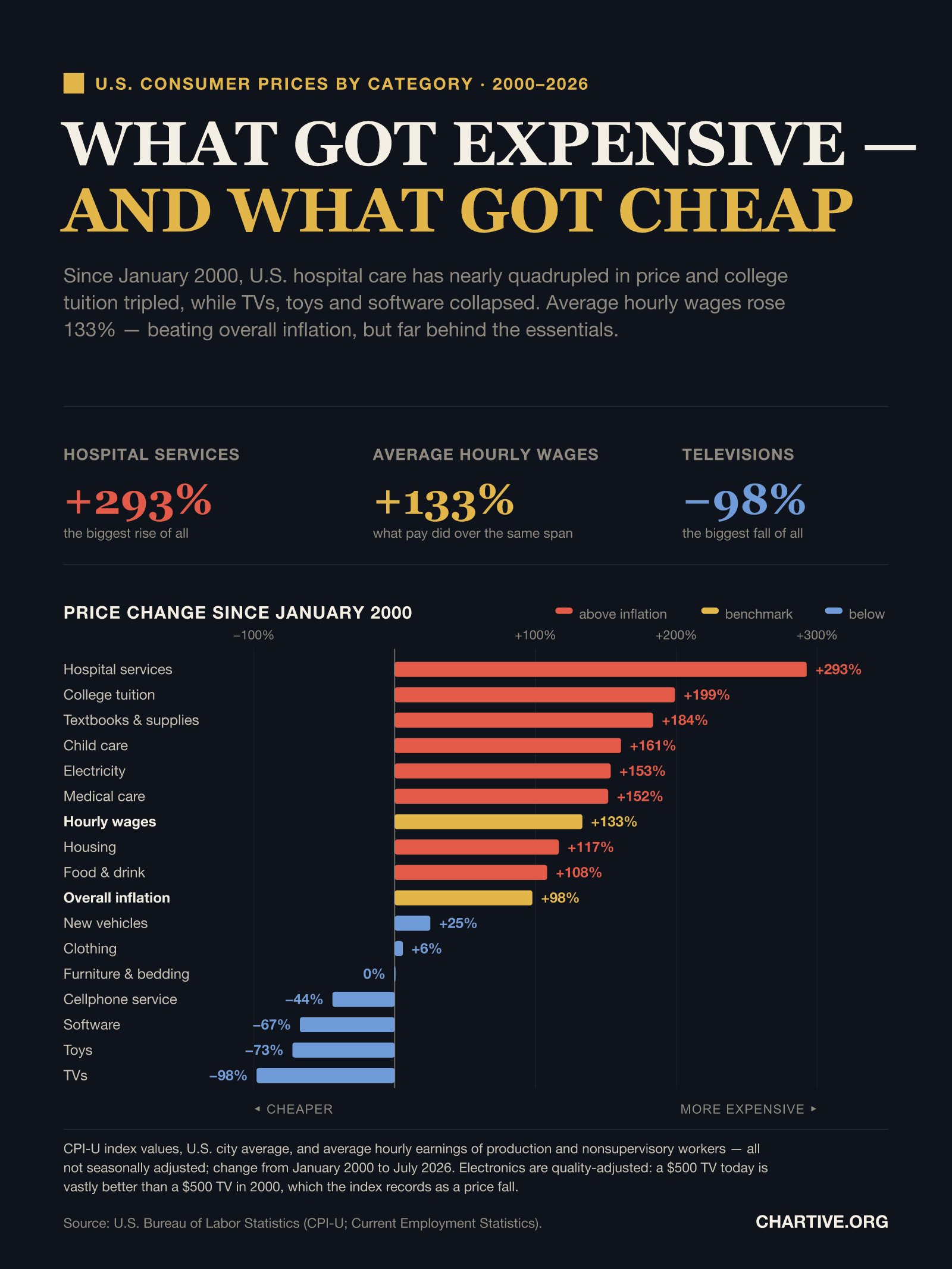
Economy
What got expensive — and what got cheap
Since January 2000, U.S. hospital care has nearly quadrupled in price and college tuition tripled, while TVs, toys and software collapsed. Average hourly wages rose 133% — beating overall inflation, but far behind the essentials.
Chartive Editorial
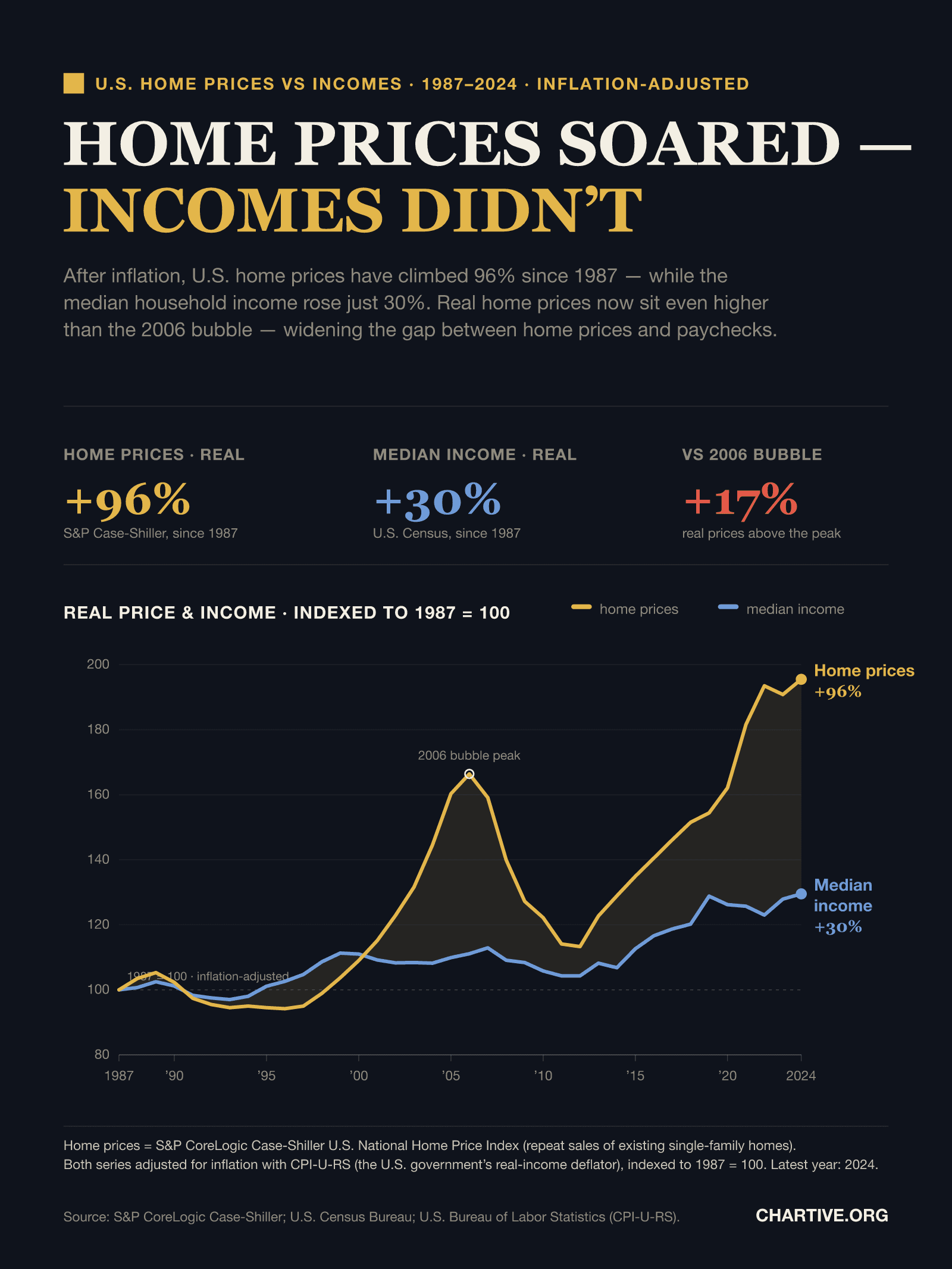
Economy
Home prices soared — incomes didn't
After inflation, U.S. home prices climbed 96% between 1987 and 2024 while the median household income rose just 30% — pushing real prices above even the 2006 bubble.
Chartive Editorial
Economy
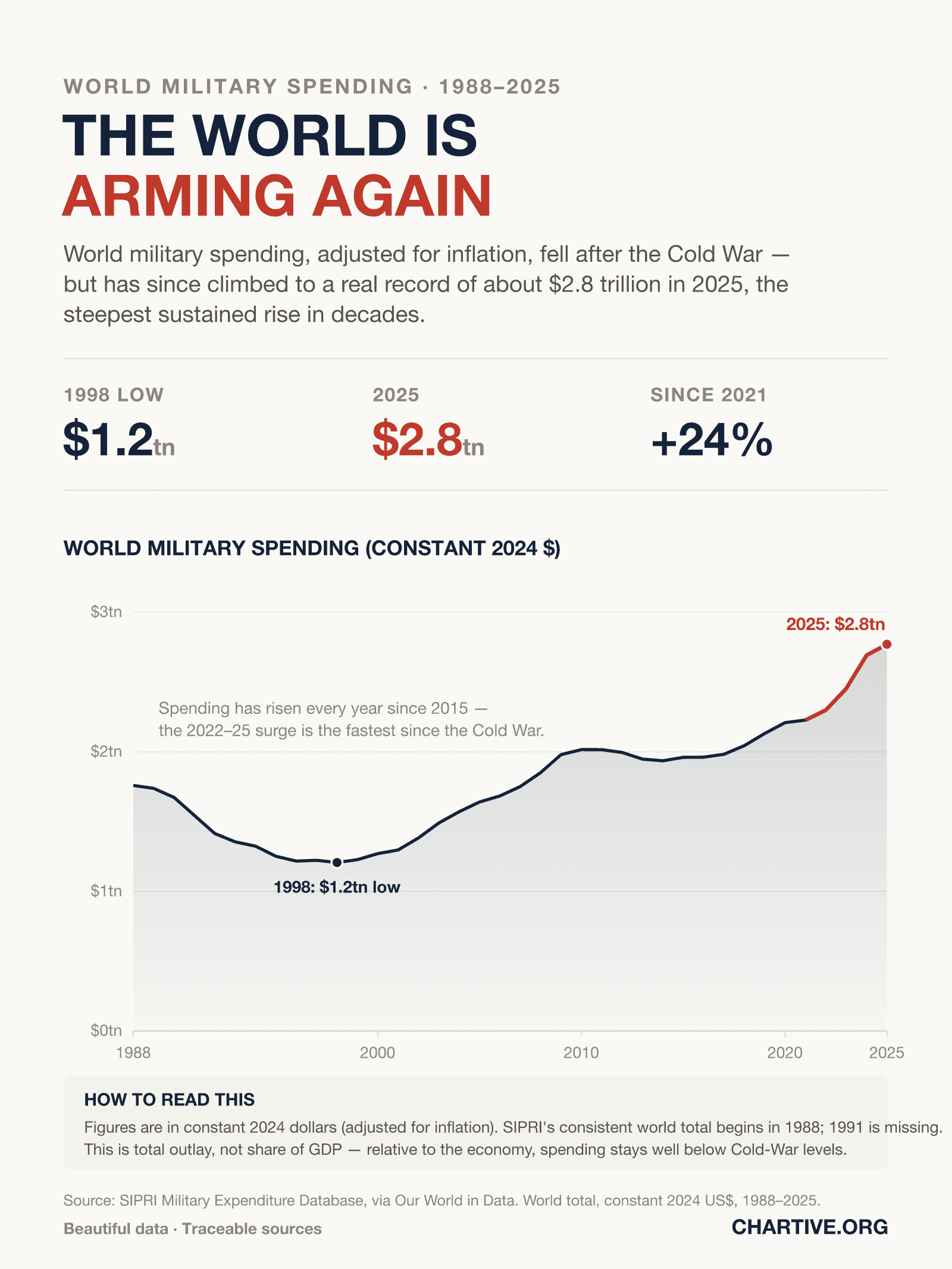
The world is arming again
World military spending, adjusted for inflation, fell after the Cold War — but has since climbed to a real record of about $2.8 trillion in 2025, the steepest sustained rise in decades.
Chartive Editorial
Health
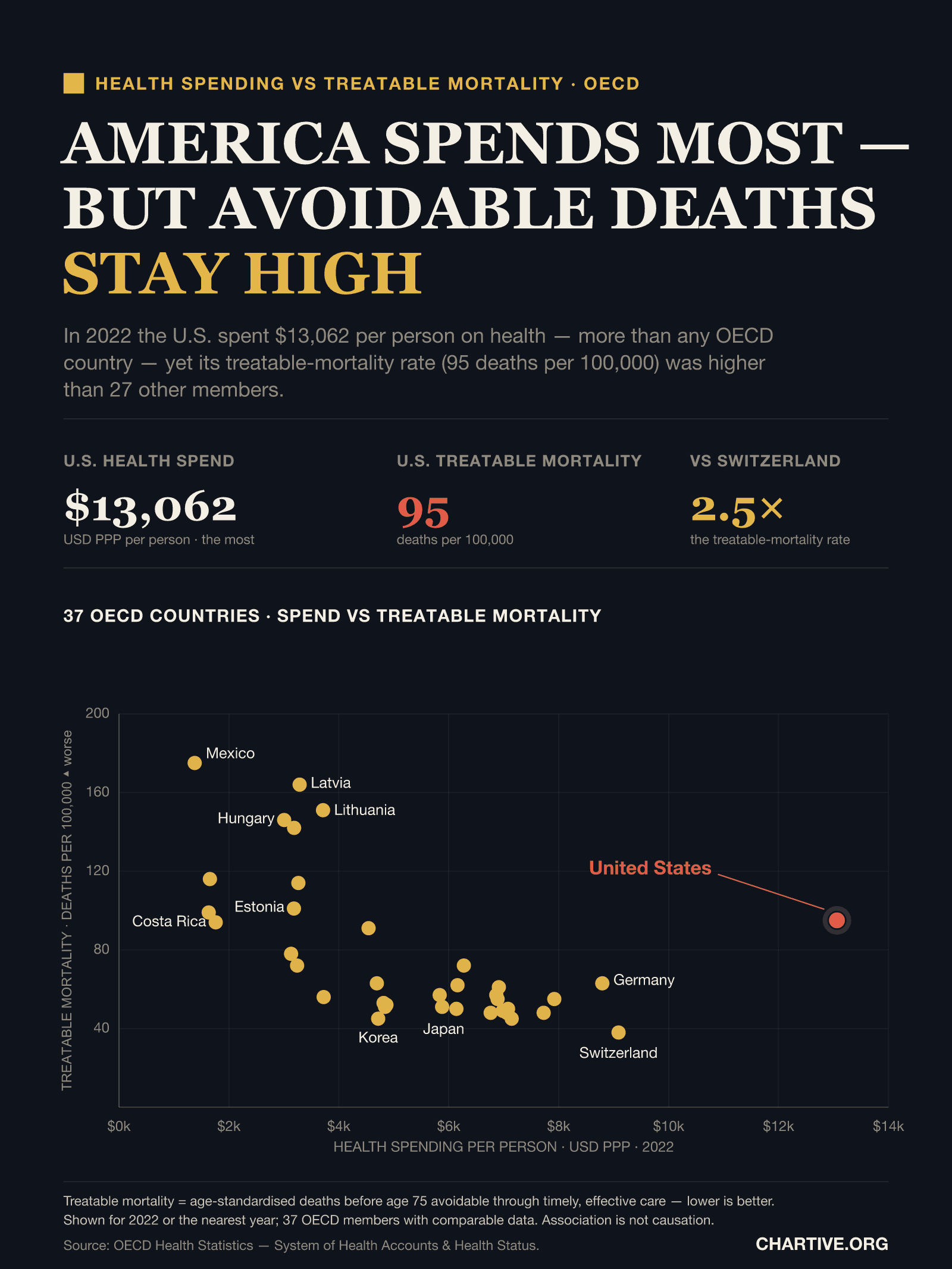
America spends the most on health — but avoidable deaths stay high
In 2022 the U.S. spent $13,062 per person on health — more than any OECD country — yet its treatable-mortality rate (95 deaths per 100,000) was higher than 27 other members.
Chartive Editorial
Technology
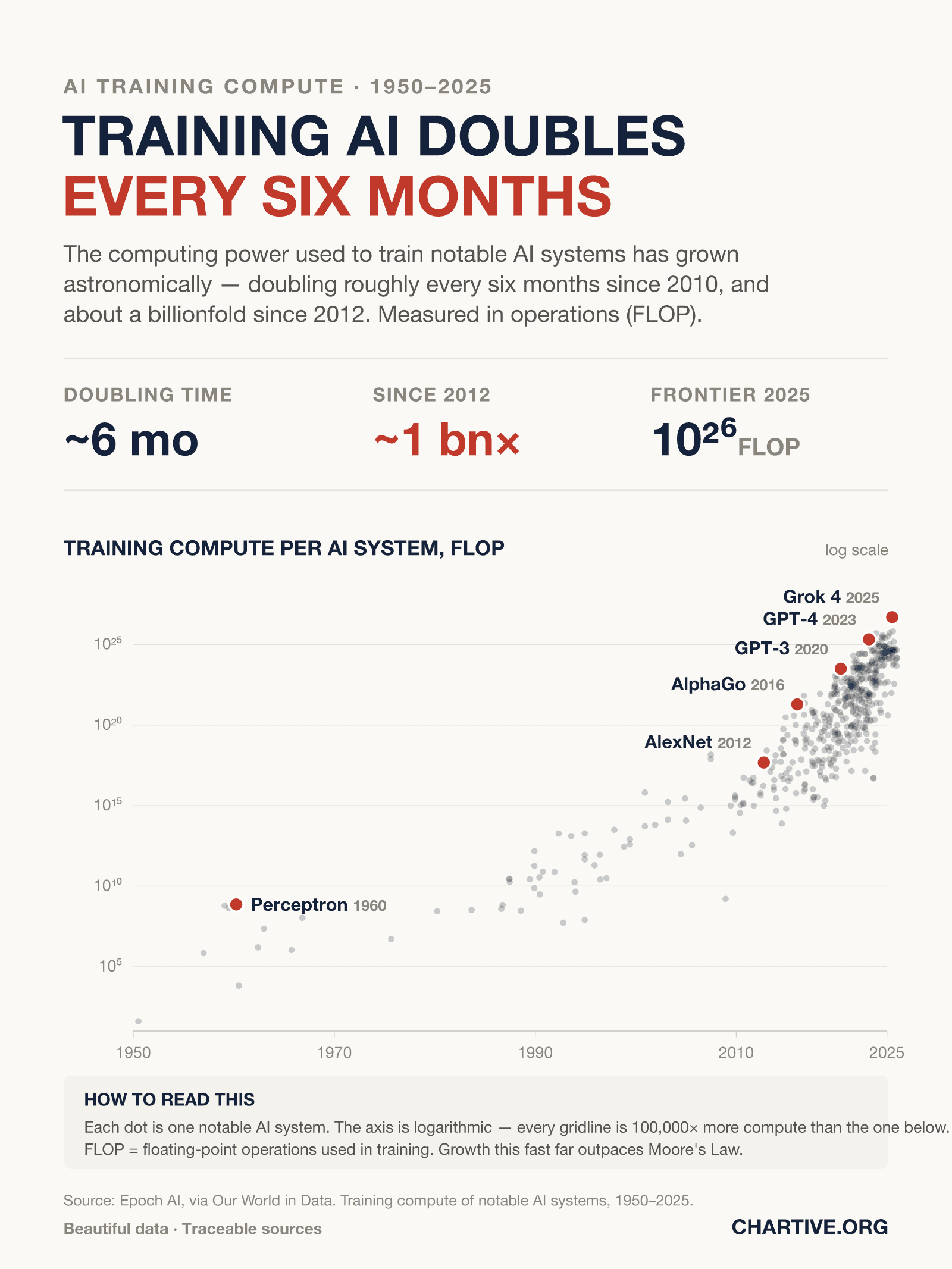
Training AI doubles every six months
The computing power used to train notable AI systems has grown astronomically — doubling roughly every six months since 2010, and about a billionfold since 2012. Measured in floating-point operations (FLOP).
Mara Ellison
Society
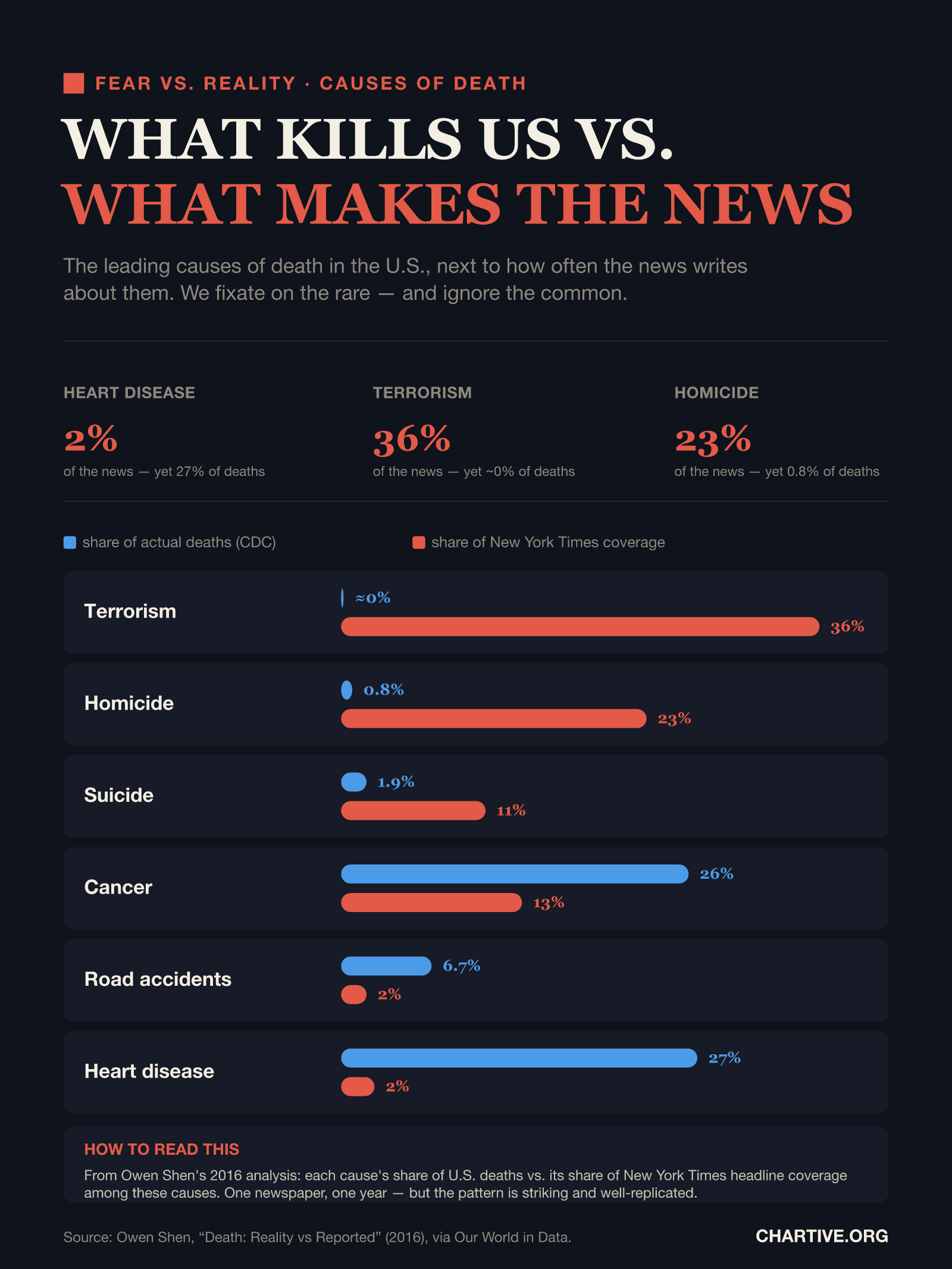
What kills us vs. what makes the news
The leading causes of death in the U.S., next to how often the news writes about them. We fixate on the rare — and ignore the common.
Chartive Editorial
Society
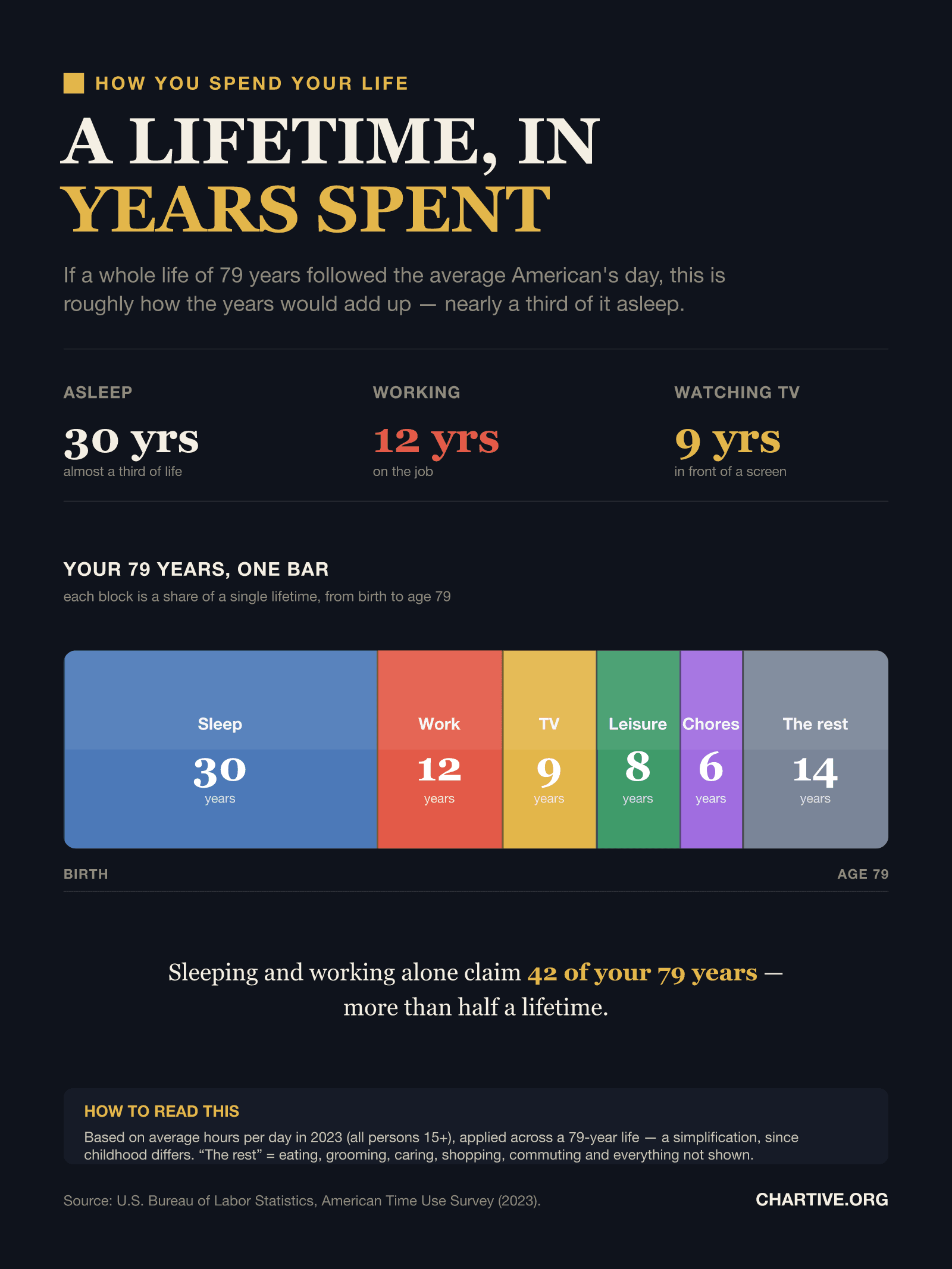
How you'll spend a 79-year life
If a whole life of 79 years followed the average American's day, this is roughly how the years add up — nearly a third of it asleep, and more than half sleeping or working.
Chartive Editorial
Health
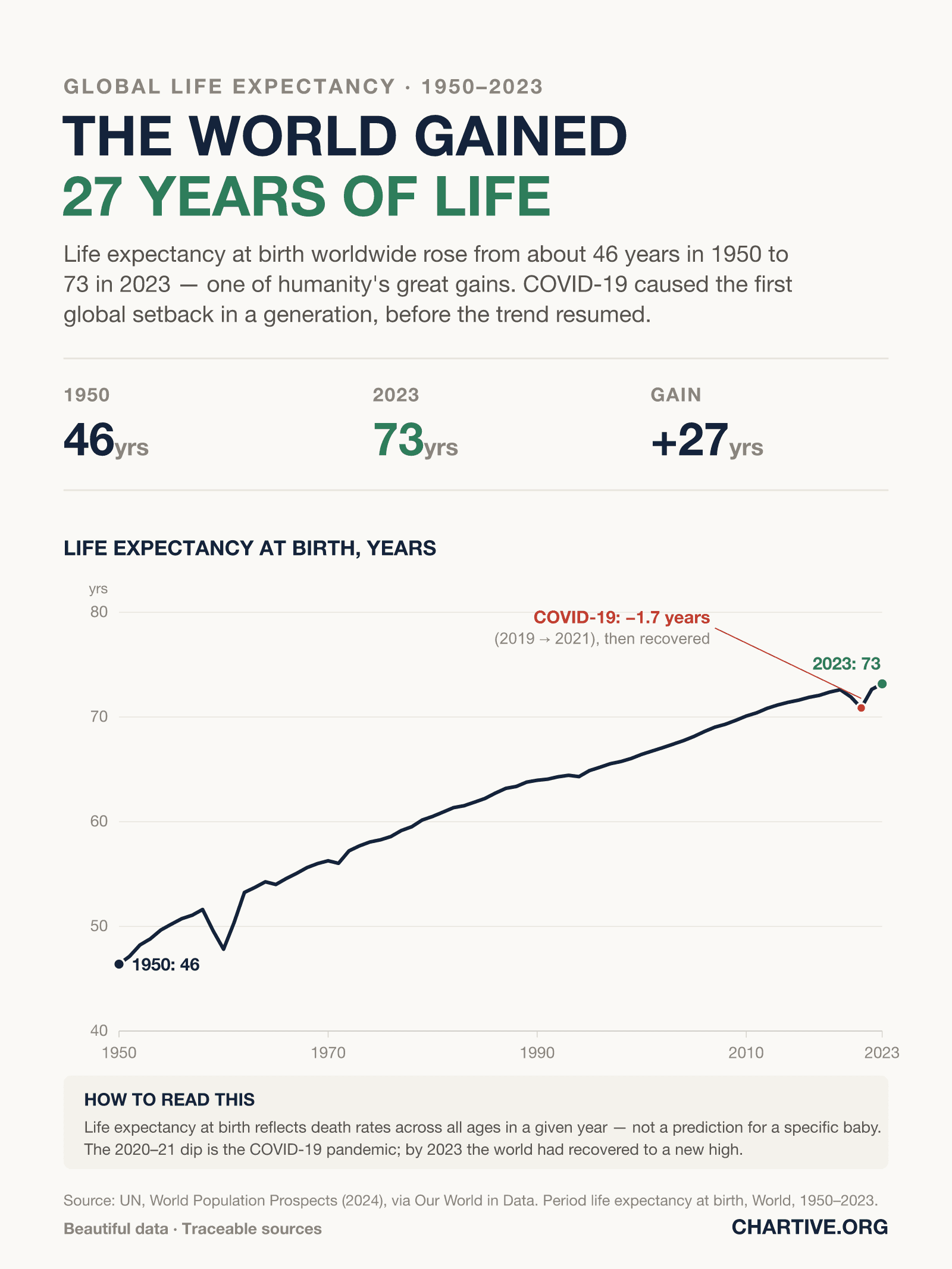
The world gained 27 years of life
Life expectancy at birth worldwide rose from about 46 years in 1950 to 73 in 2023 — one of humanity's great gains. COVID-19 caused the first global setback in a generation, before the trend resumed.
Chartive Editorial
Demographics
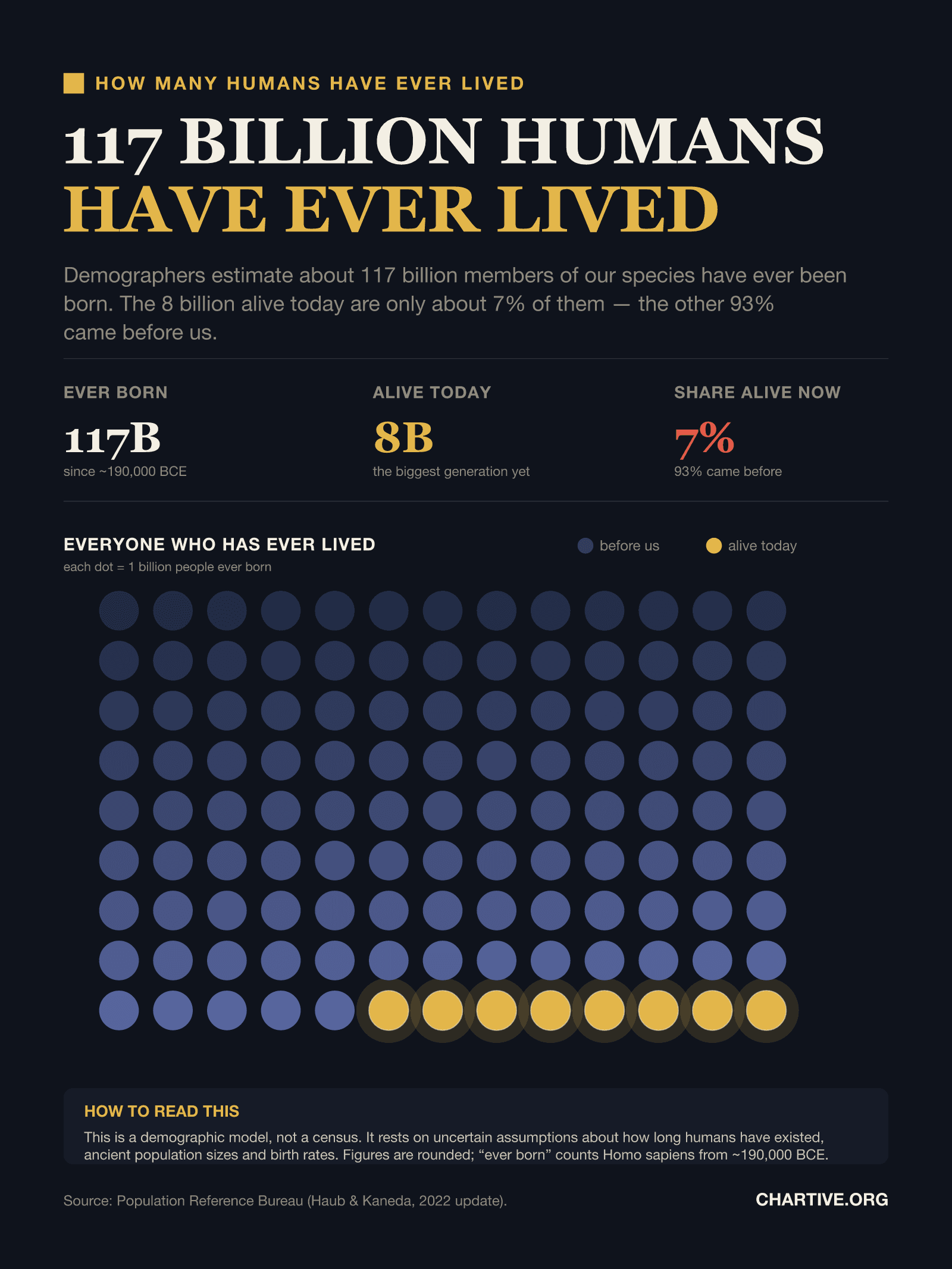
117 billion humans have ever lived
Demographers estimate about 117 billion members of our species have ever been born. The 8 billion alive today are only about 7% of them — the other 93% came before us.
Chartive Editorial
Climate
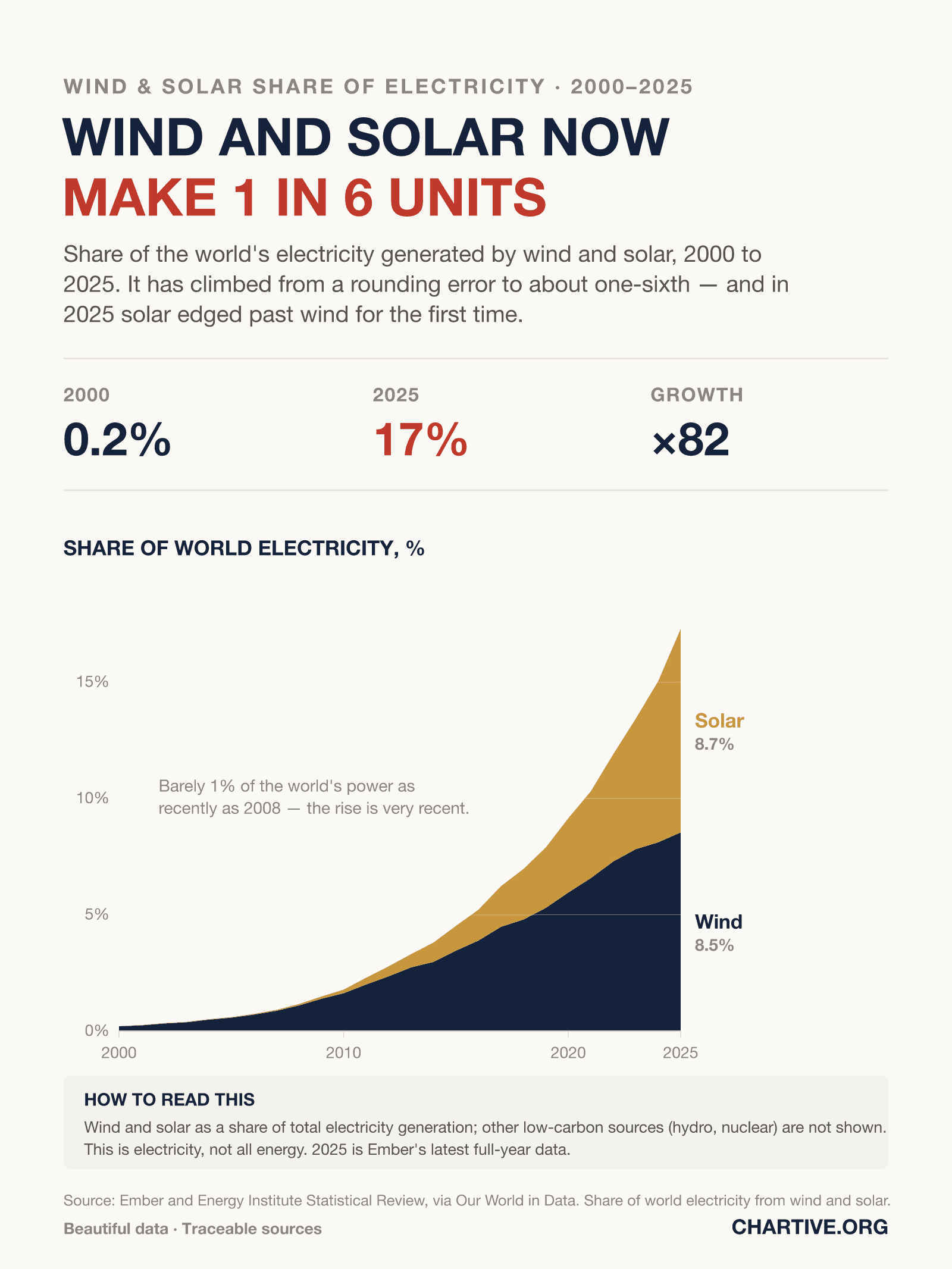
Wind and solar reached one-sixth of world electricity
Share of the world's electricity generated by wind and solar, 2000 to 2025. It has climbed from a rounding error to about one-sixth — and in 2025 solar edged past wind for the first time.
Daniel Okafor
Demographics
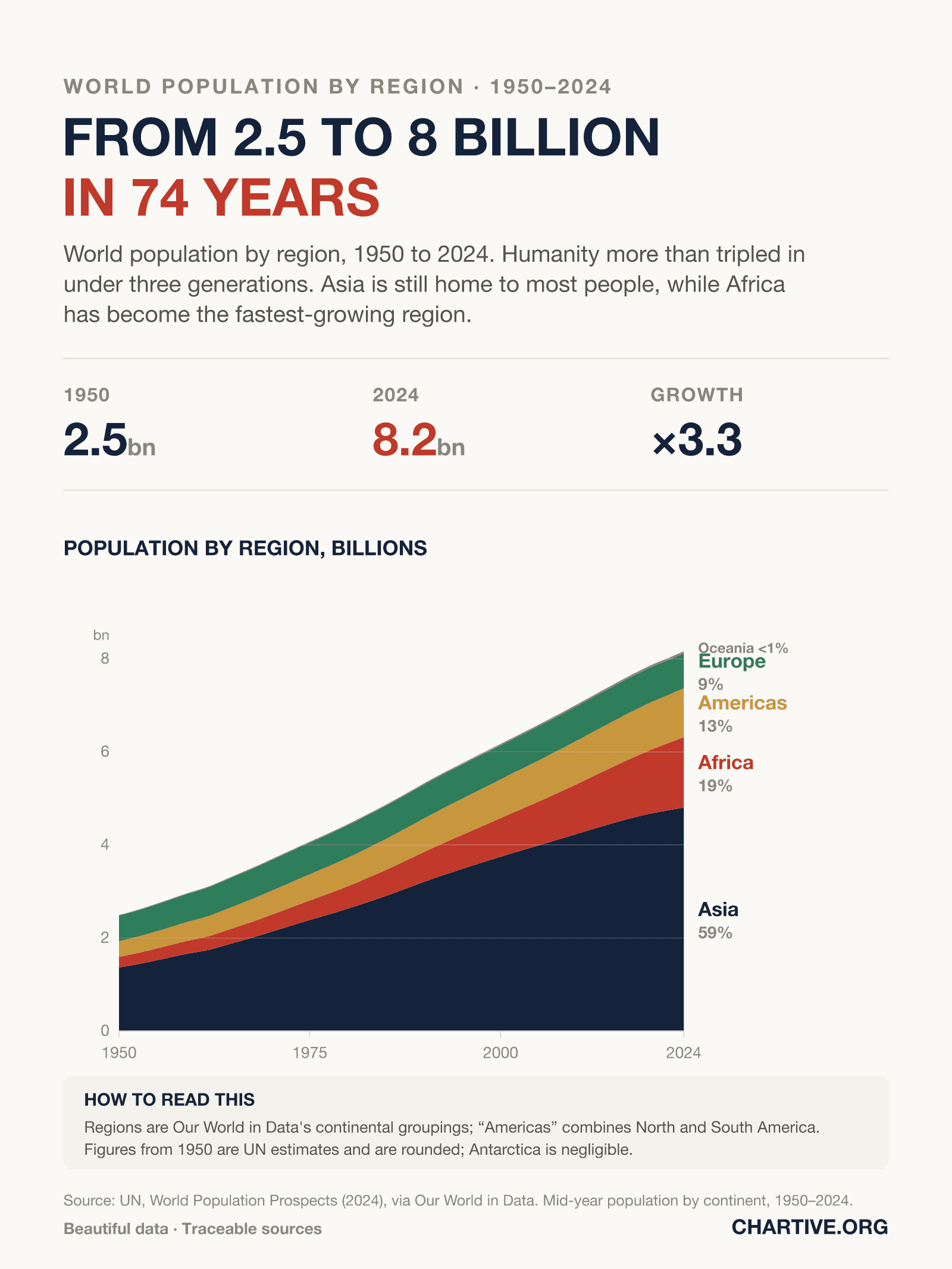
From 2.5 to 8 billion in 74 years
World population by region, 1950 to 2024. Humanity more than tripled in under three generations — Asia is still home to most people, while Africa has become the fastest-growing region.
Mara Ellison
Economy
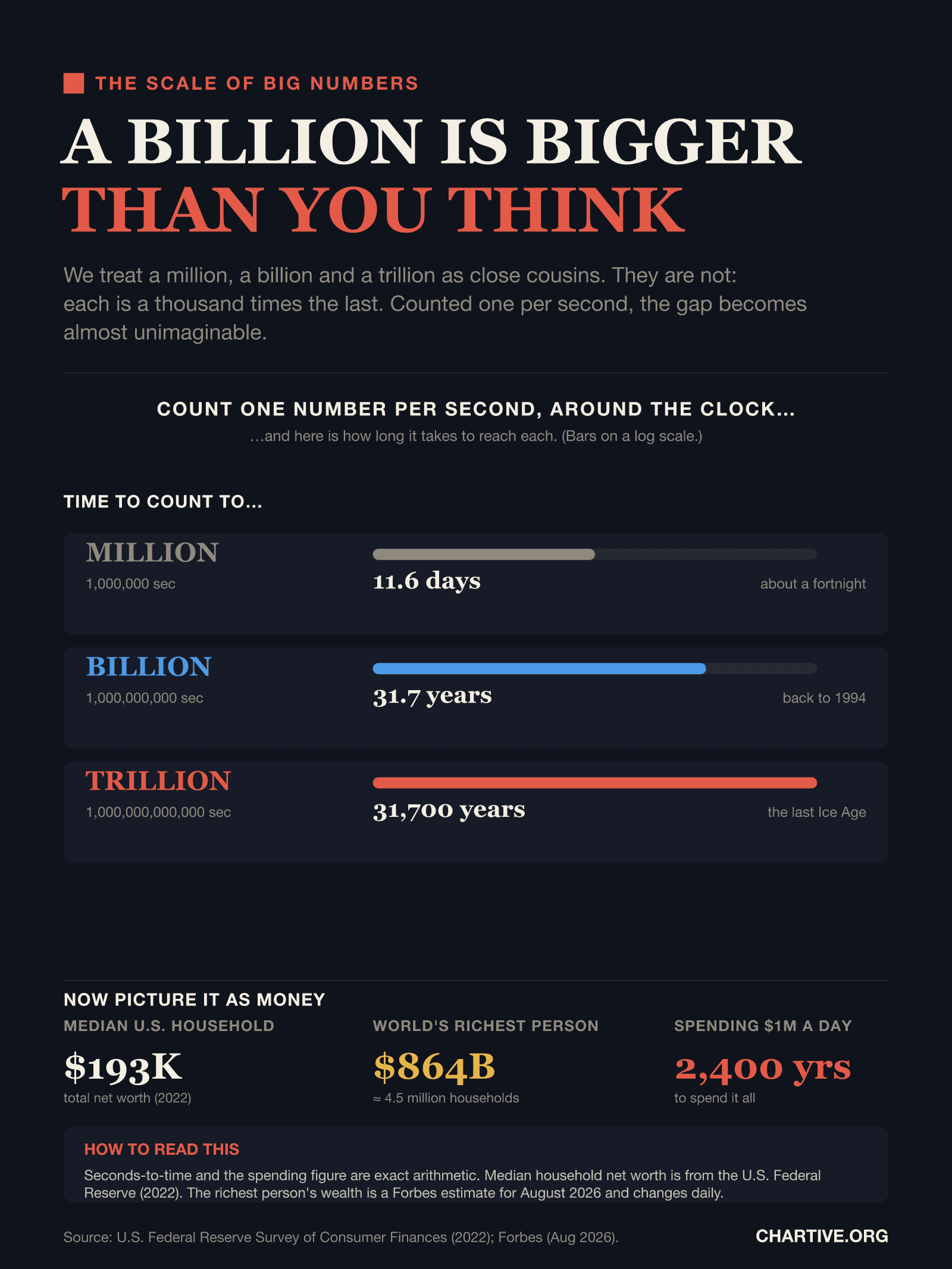
A billion is bigger than you think
We treat a million, a billion and a trillion as close cousins. They are not — each is a thousand times the last. Counted one per second, the gap becomes almost unimaginable.
Chartive Editorial
Climate
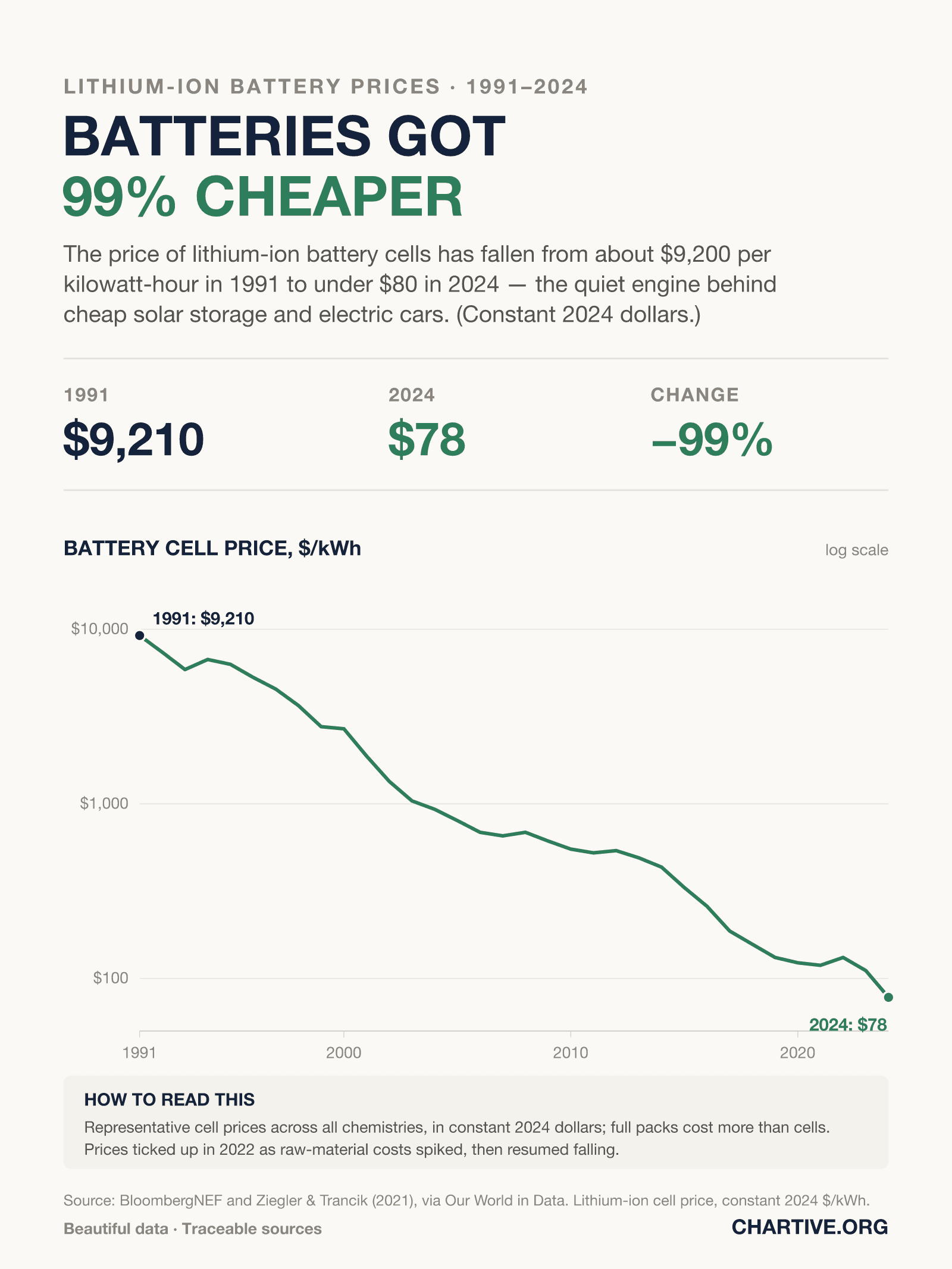
Batteries got 99% cheaper
The price of lithium-ion battery cells has fallen from about $9,200 per kilowatt-hour in 1991 to under $80 in 2024 (in constant 2024 dollars) — the quiet engine behind cheap solar storage and electric cars.
Daniel Okafor
Technology
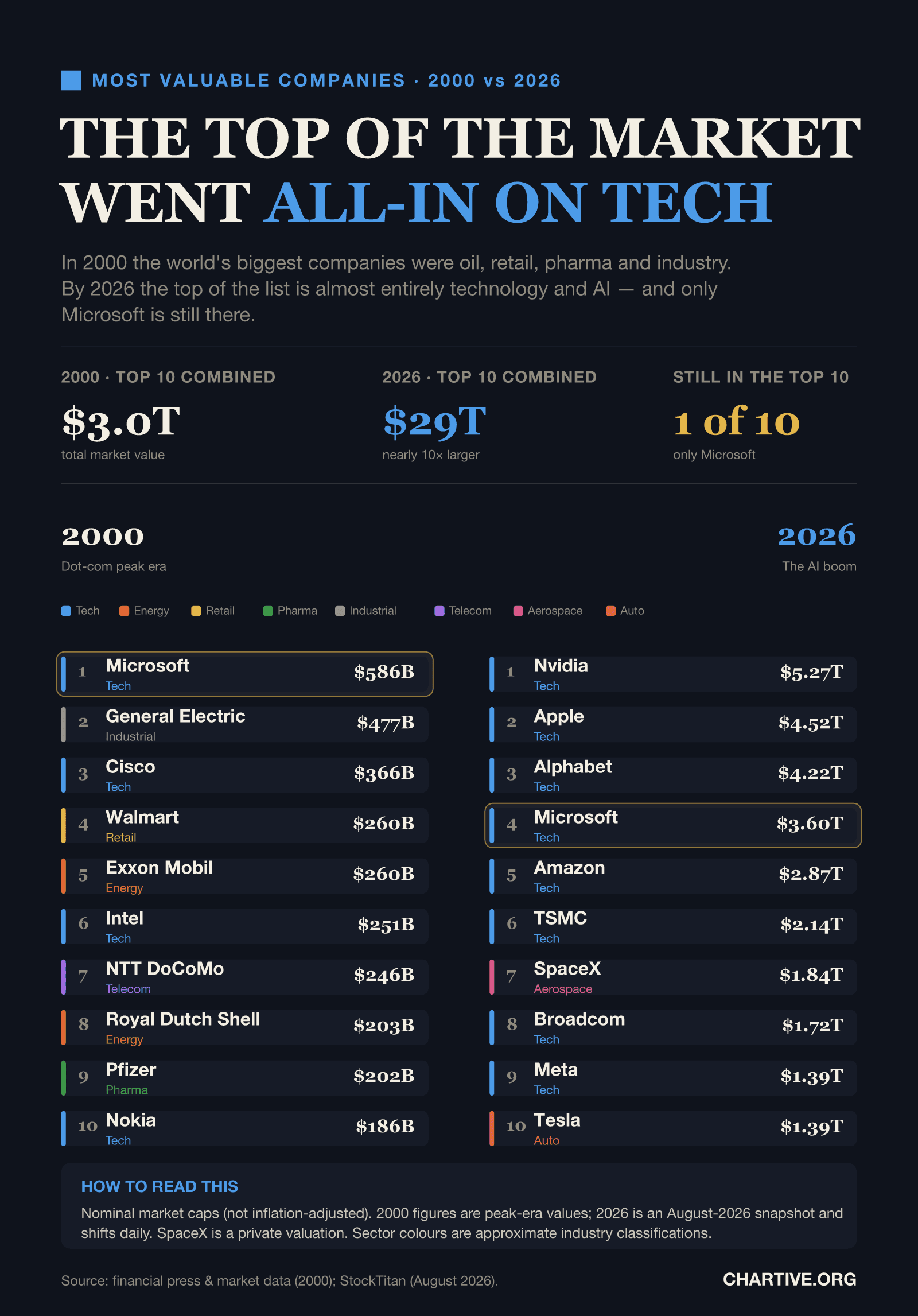
The top of the market went all-in on tech
In 2000 the world's biggest companies were oil, retail, pharma and industry. By 2026 the top of the list is almost entirely technology and AI — and only Microsoft is still there.
Chartive Editorial
Health
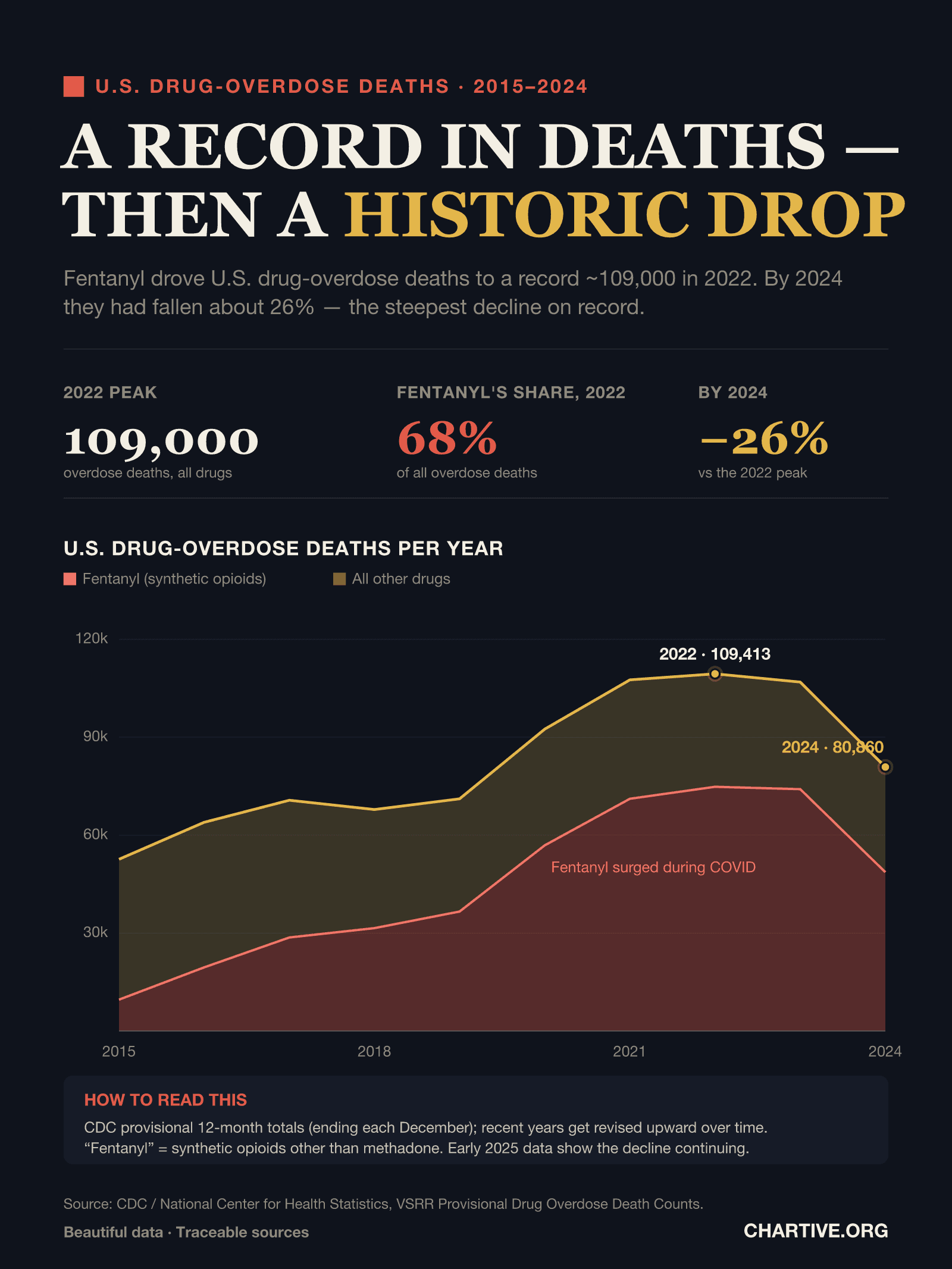
U.S. overdose deaths hit a record — then a historic drop
Fentanyl drove U.S. drug-overdose deaths to a record of about 109,000 in 2022. By 2024 they had fallen roughly 26% — the steepest decline on record.
Chartive Editorial
Climate
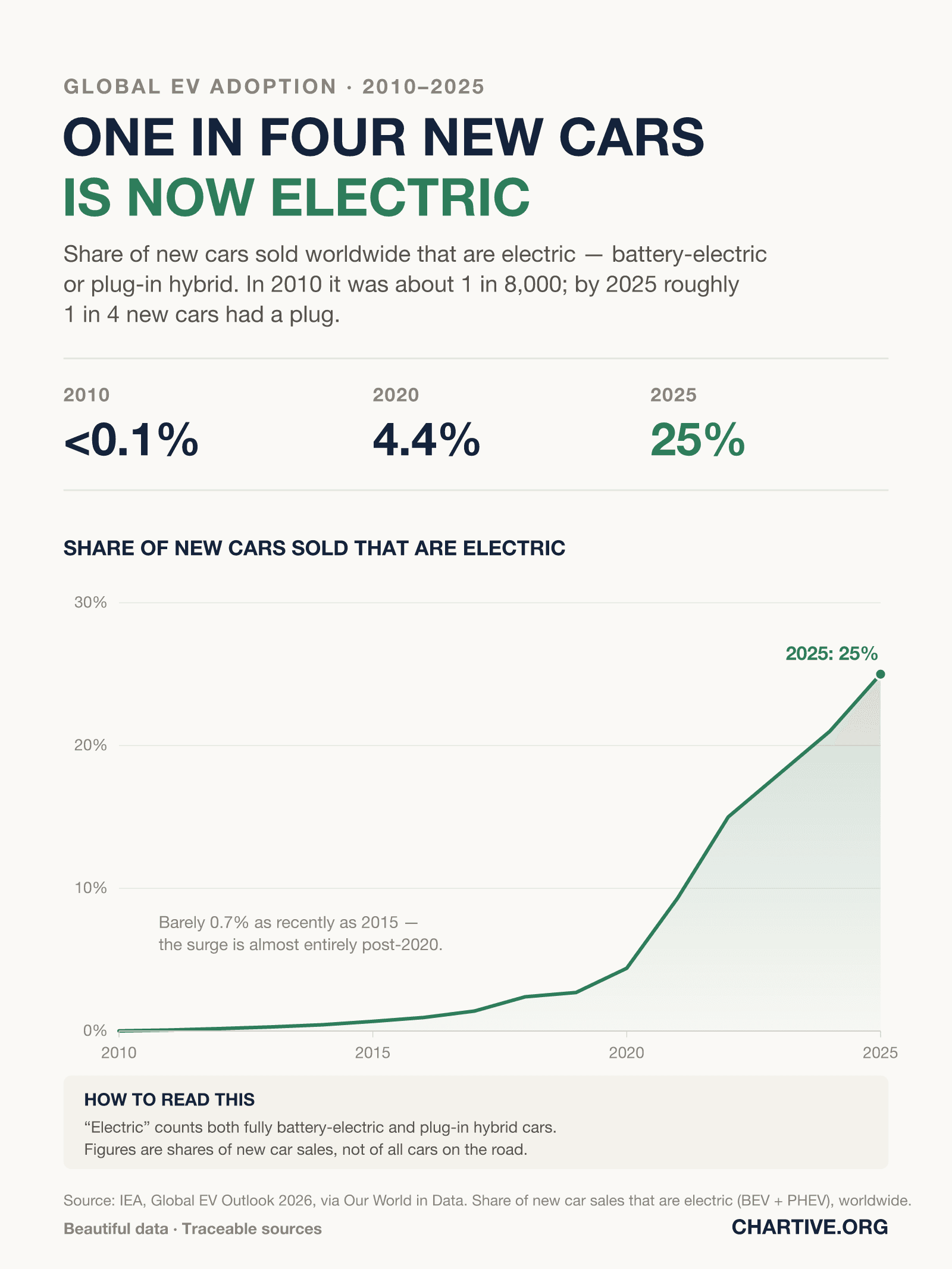
One in four new cars is now electric
Share of new cars sold worldwide that are electric — battery-electric or plug-in hybrid. In 2010 it was about 1 in 8,000; by 2025 roughly one in four new cars had a plug.
Chartive Editorial
Health
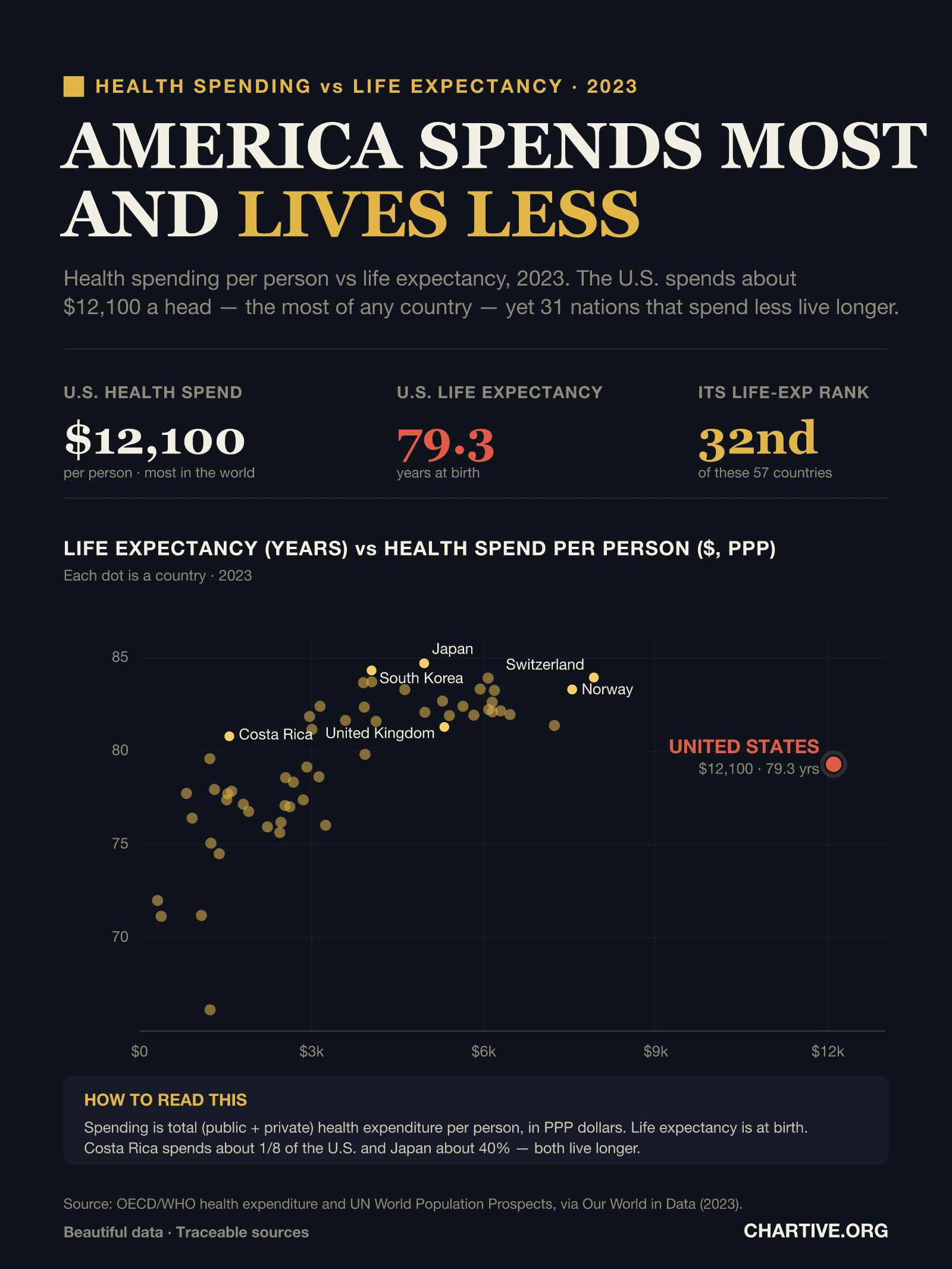
America spends the most on health — and lives less
Health spending per person vs life expectancy across 57 countries in 2023. The U.S. spends about $12,100 a head — the most of any country — yet 31 nations that spend less live longer.
Chartive Editorial
Economy
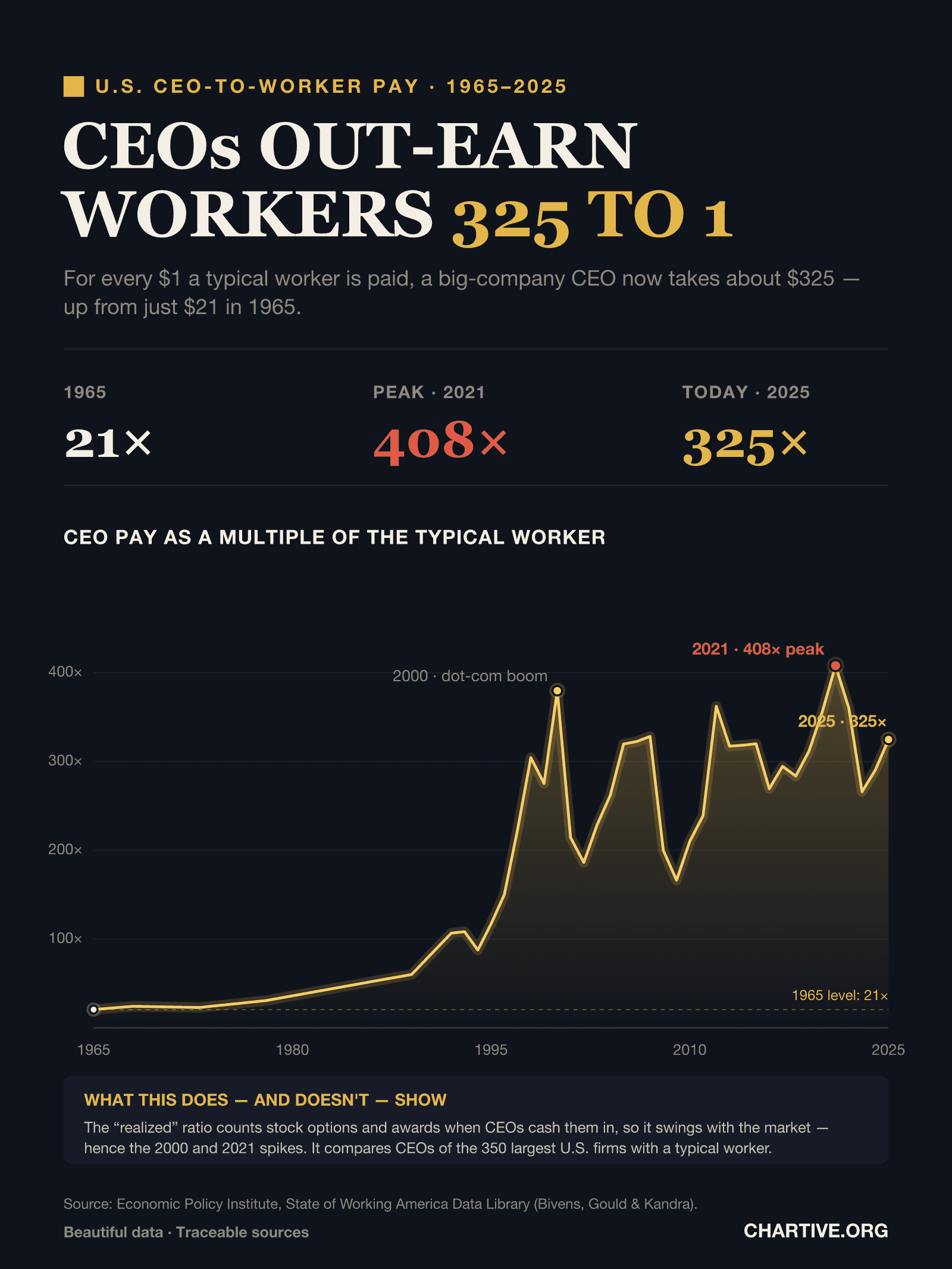
CEOs out-earn workers 325 to 1
How many times more the average big-company CEO is paid than a typical U.S. worker — up from about 21-to-1 in 1965 to roughly 325-to-1 in 2025, after peaking at 408-to-1 in 2021.
Chartive Editorial
History
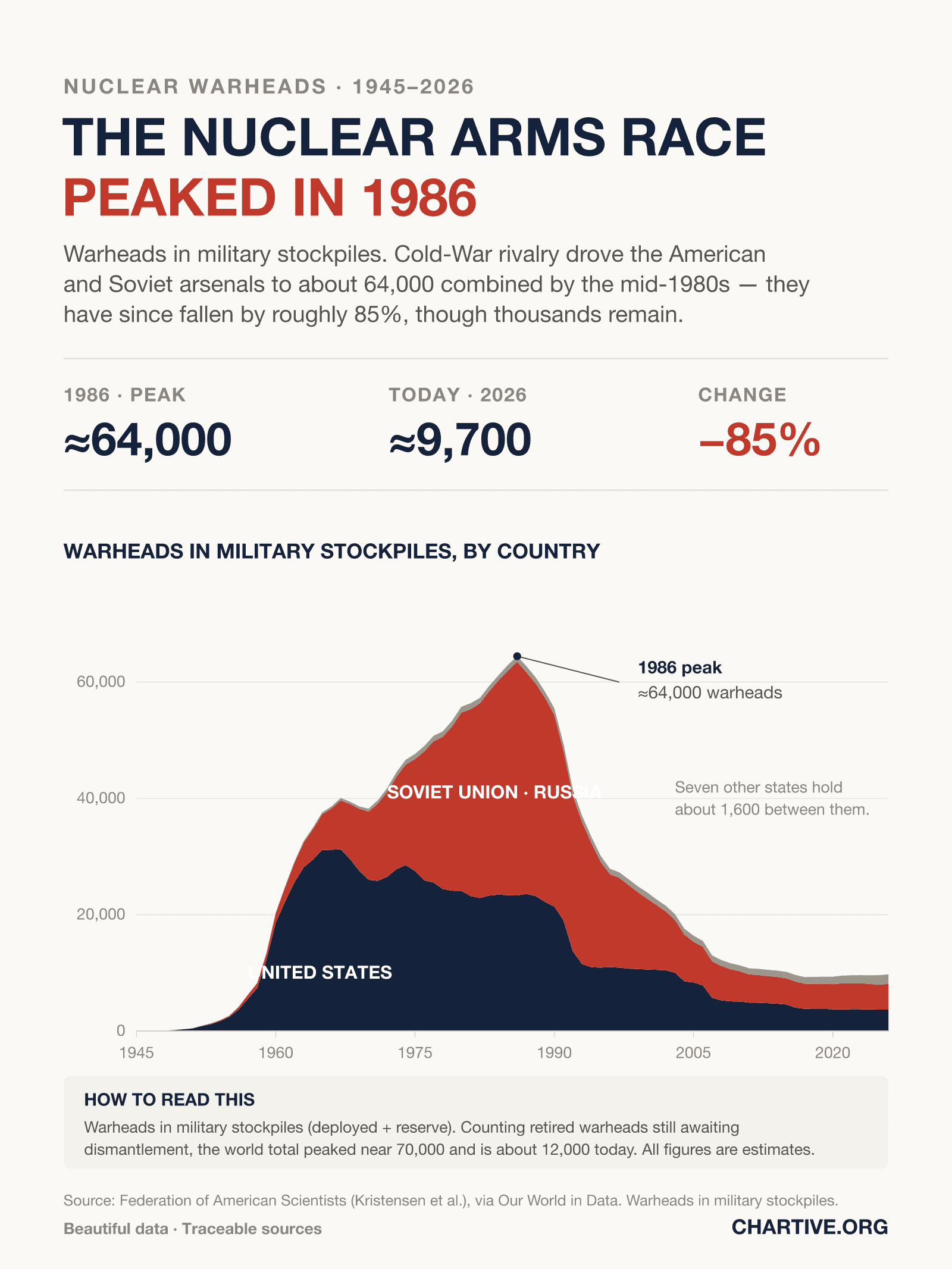
The nuclear arms race peaked in 1986
Warheads in military stockpiles. Cold-War rivalry drove the American and Soviet arsenals to about 64,000 combined by the mid-1980s; they have since fallen by roughly 85%, though thousands remain.
Chartive Editorial
Society
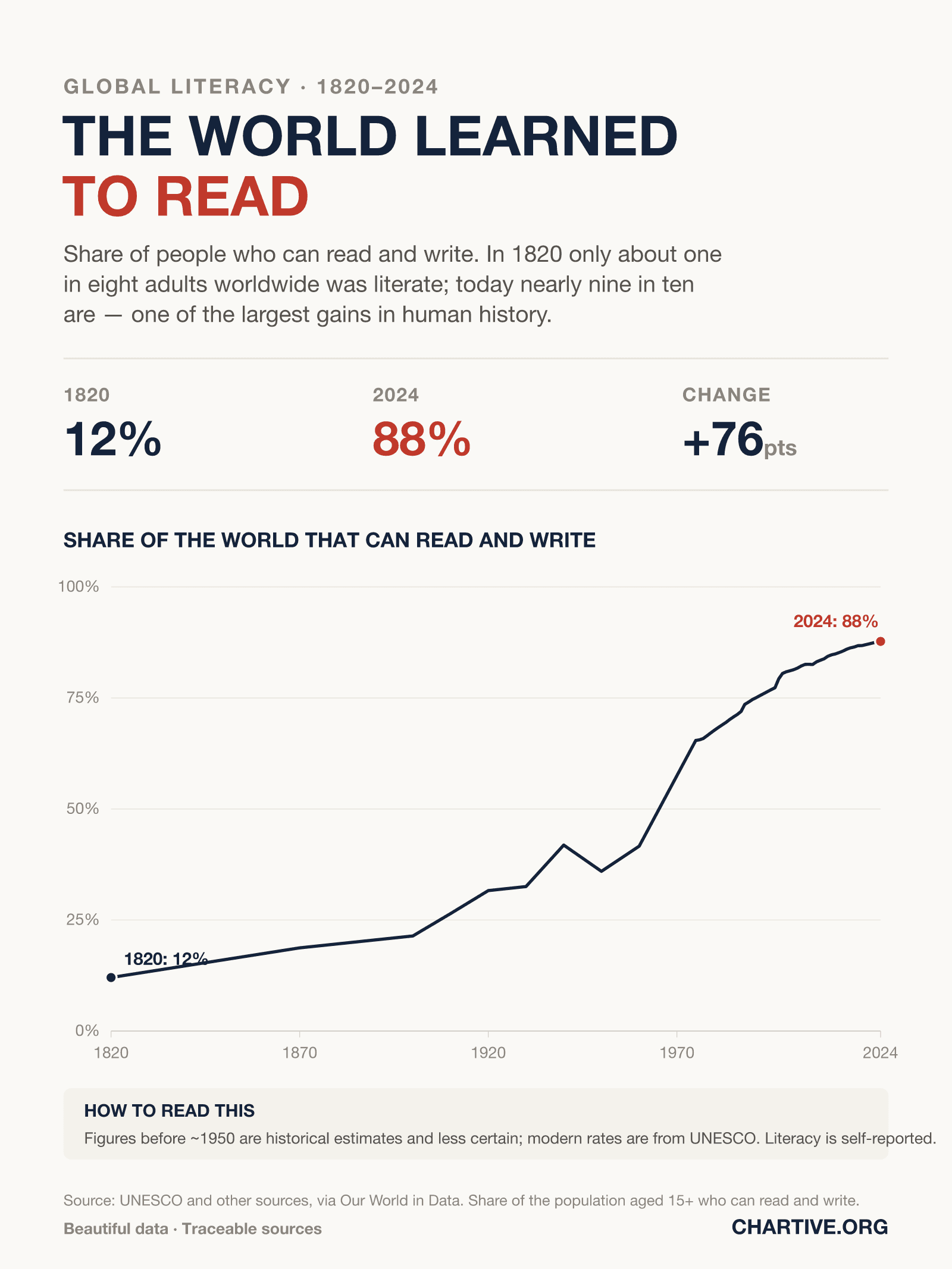
The world learned to read
The share of people who can read and write has risen from about 12% in 1820 to roughly 88% today — from one in eight adults to nearly nine in ten.
Chartive Editorial
Economy
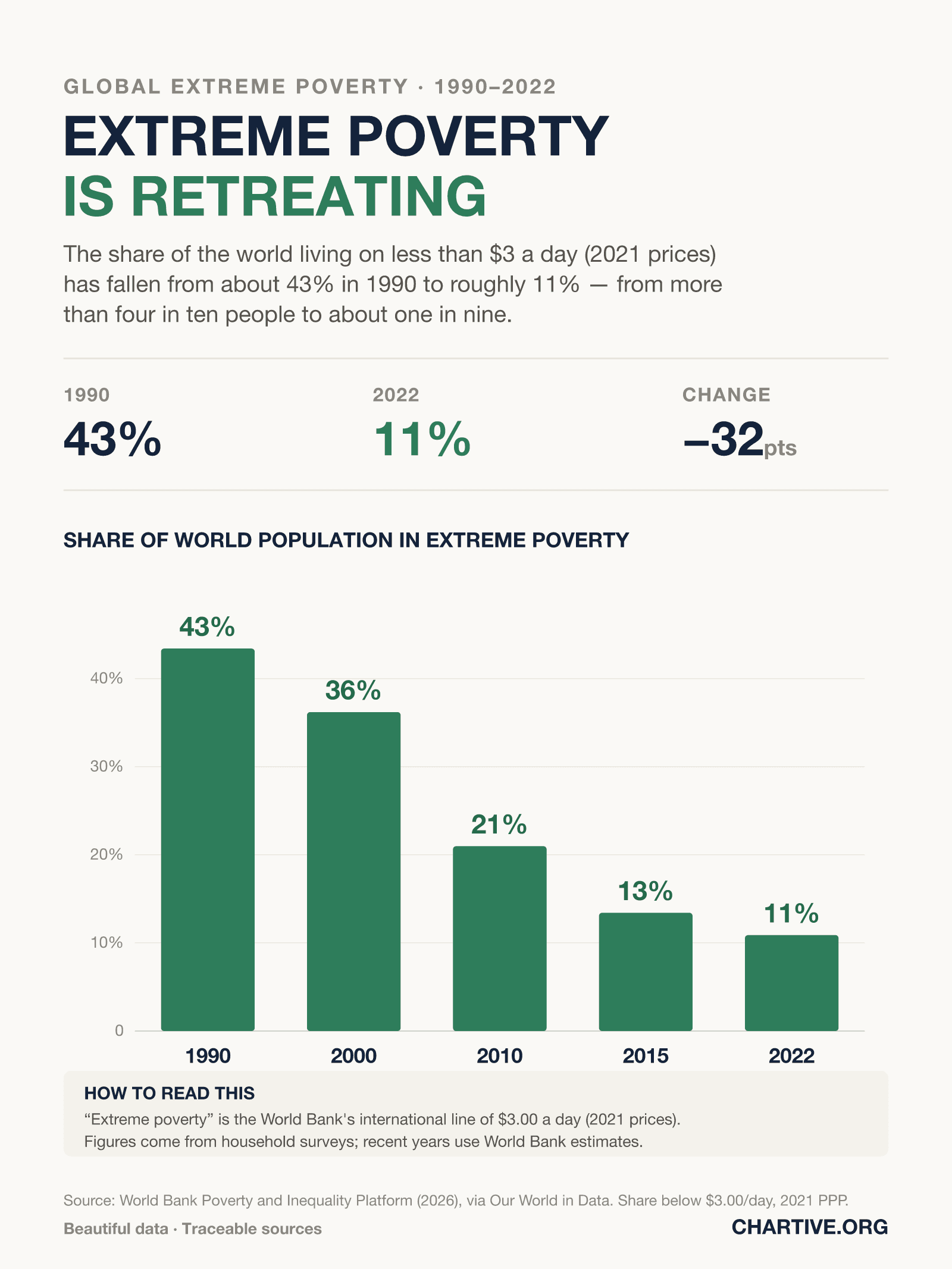
Extreme poverty is retreating
The share of the world living on less than $3 a day (2021 prices) has fallen from about 43% in 1990 to roughly 11% — from more than four in ten people to about one in nine.
Daniel Okafor
Climate
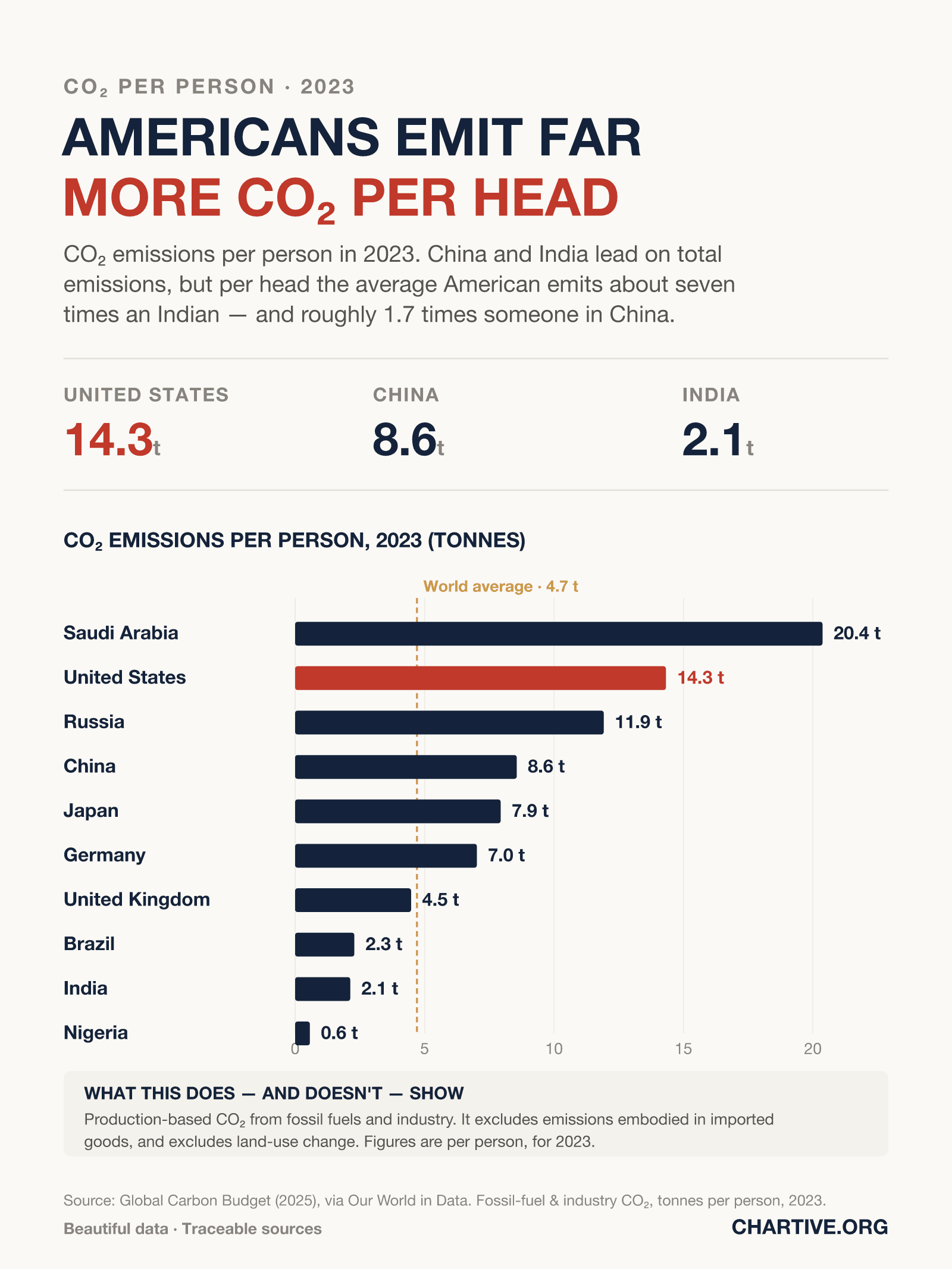
Americans emit far more CO₂ per person than China or India
CO₂ emissions per person in 2023. China and India lead on total emissions, but per head the average American emits about seven times an Indian — and roughly 1.7 times someone in China.
Chartive Editorial
Technology
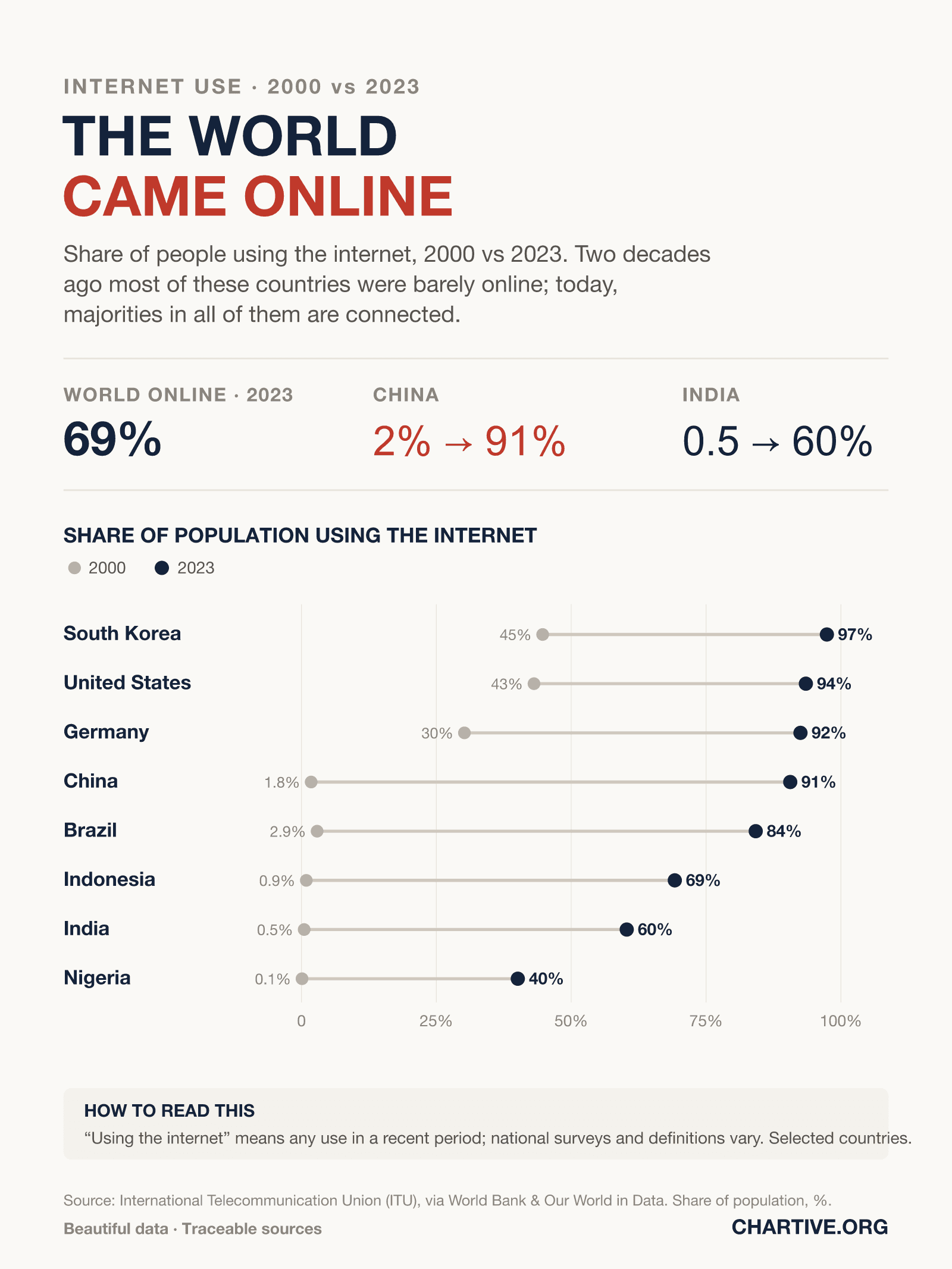
The world came online
Share of people using the internet, 2000 vs 2023. Two decades ago most of these countries were barely online; today, majorities in all of them are connected.
Daniel Okafor
Health
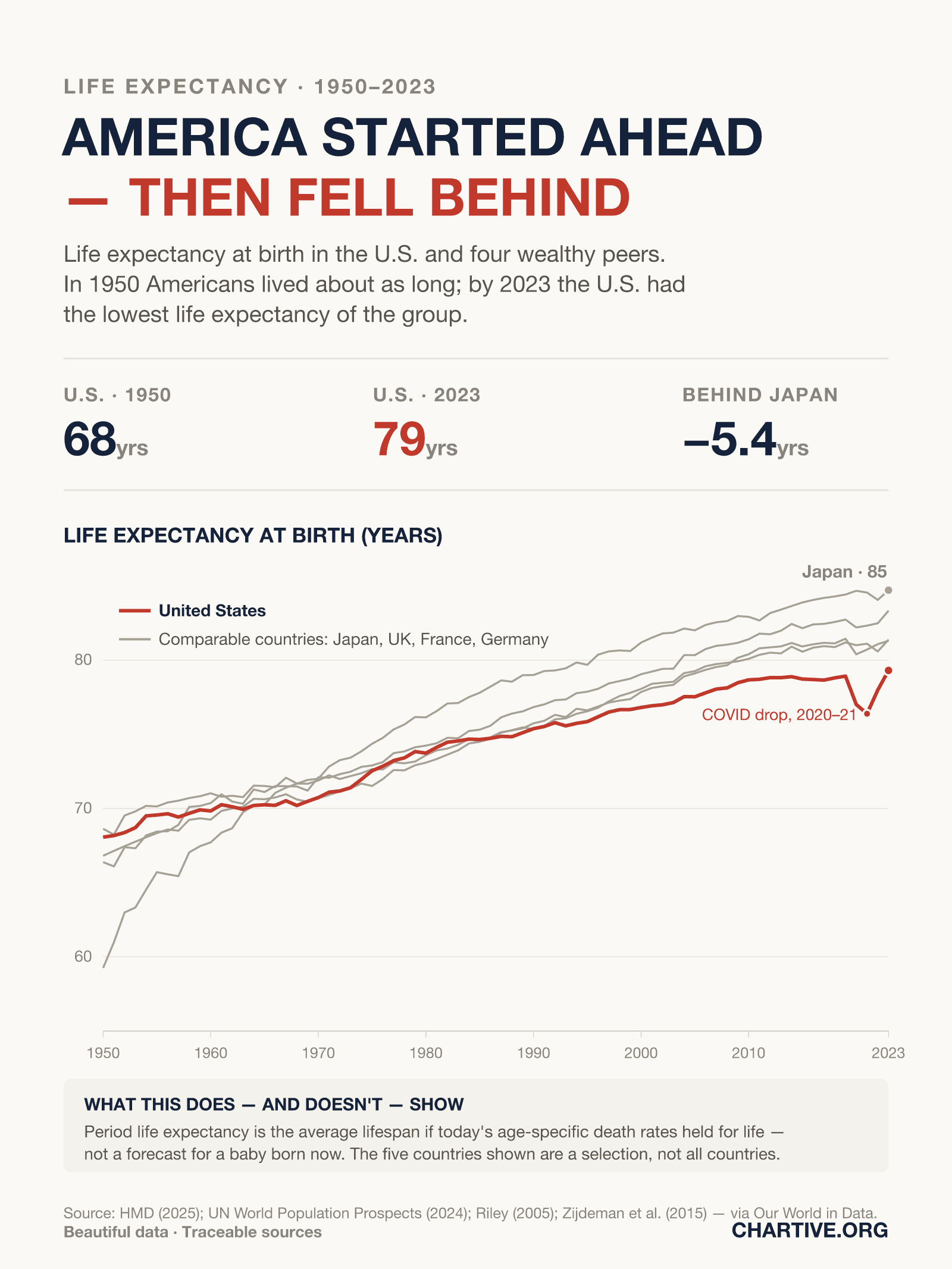
America started ahead on life expectancy — then fell behind
In 1950 the United States lived about as long as other wealthy countries. By 2023 it had the lowest life expectancy of the group — and lost the most ground during the pandemic.
Mara Ellison
Climate
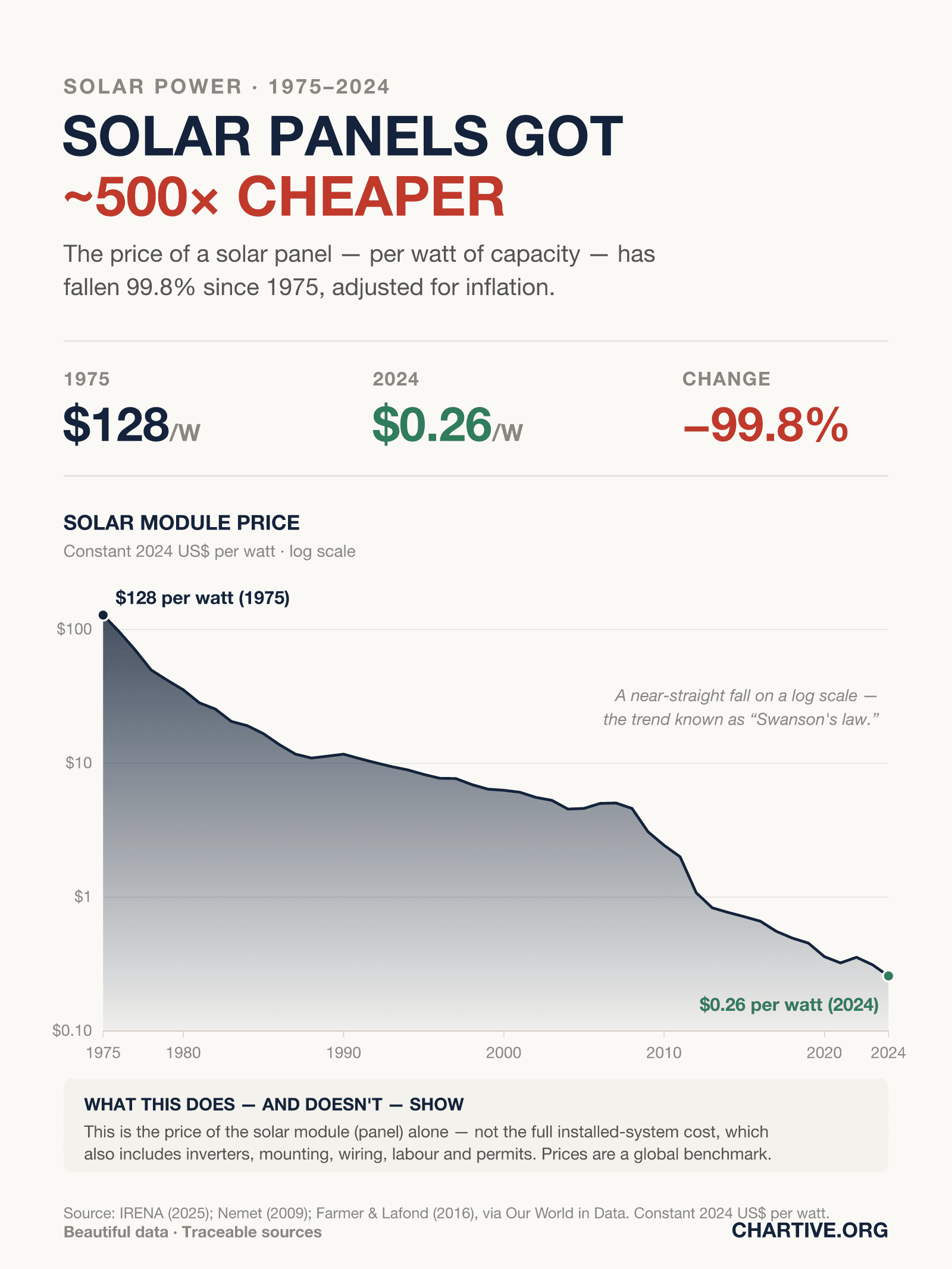
Solar panels are about 500 times cheaper than in 1975
The price of a solar panel, per watt of capacity, has fallen 99.8% since 1975 — one of the fastest sustained cost declines of any technology.
Mara Ellison
Economy
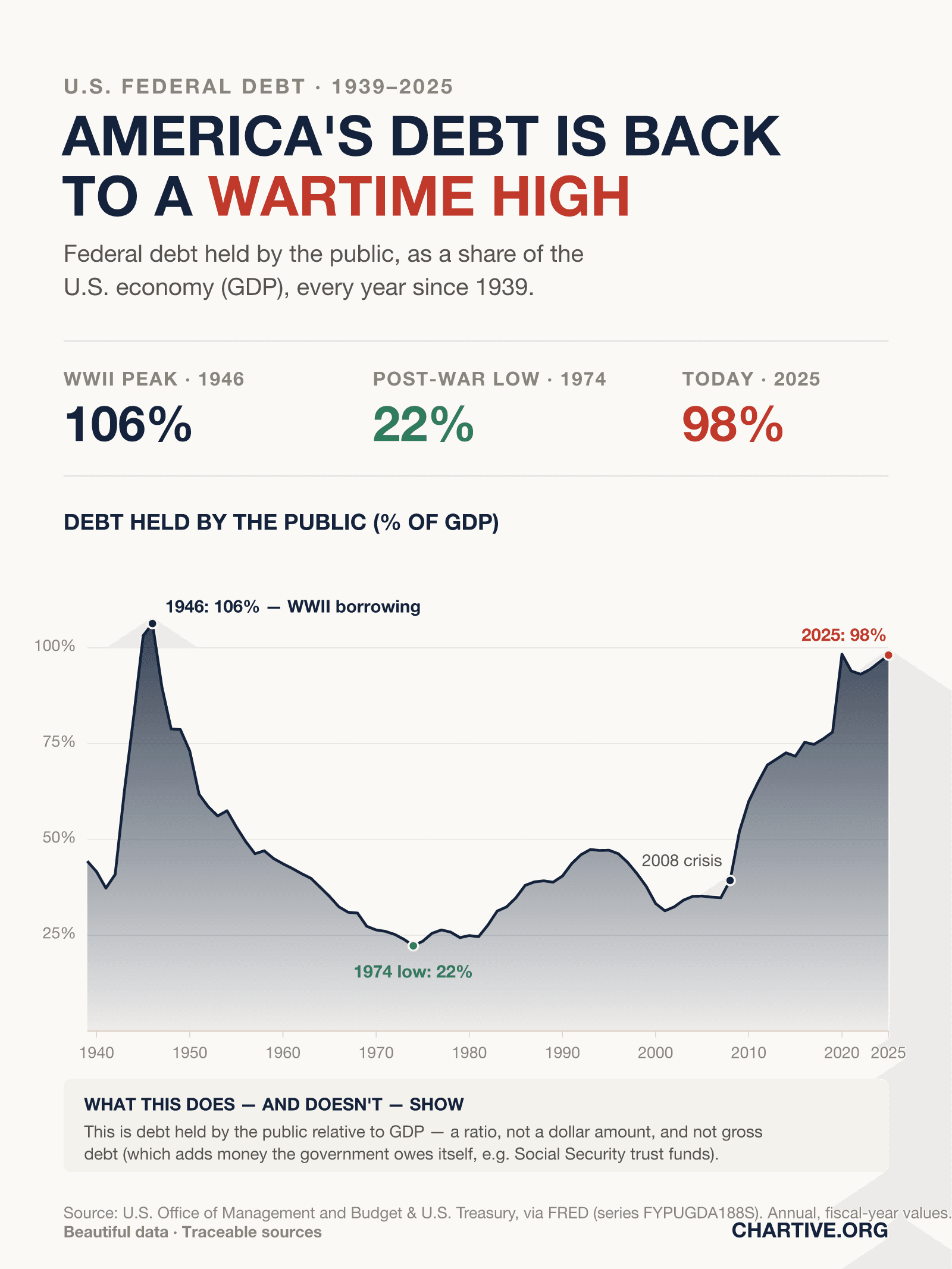
America's debt is back near its World War II peak
Federal debt held by the public reached about 98% of U.S. GDP in 2025 — close to the record 106% set in 1946, after falling as low as 22% in 1974.
Mara Ellison